Why Thousands Queue for Mehendi at Jaipur's Moti Dungri Ganesh Temple

On Sinjara before Ganesh Chaturthi, Moti Dungri in Jaipur distributes tonnes of Sojat mehendi as prasad, with a popular belief tying it to marriage blessings.
Jaipur is usually introduced through its forts, palaces, bazaars and pink-painted streets, but some of the city's most interesting traditions are much easier for a traveller to miss. One of them takes place every year at the Moti Dungri Ganesh Temple around Ganesh Chaturthi, when thousands of people gather to receive something you might not normally associate with temple prasad: mehendi.
The tradition is part of Sinjara, celebrated just before Ganesh Chaturthi. In 2026, Sinjara fell on 13 September. Mehendi is offered to Lord Ganesha during the festivities and later distributed among devotees as prasad. What makes the occasion particularly interesting is not only the scale of the distribution, but also a popular belief that has become associated with it. Many unmarried devotees come hoping to receive the mehendi and seek Lord Ganesha's blessings for marriage.
In 2026, the temple reportedly arranged around 3,500 kilograms of mehendi, brought from Sojat in Rajasthan. That's three and a half tonnes of henna for a single religious celebration, and gives some idea of just how large the gathering has become. Local reports from that day also described heavy crowds, early distribution and the mehendi running out by around 7pm, so travellers hoping to collect prasad should plan for queues rather than a quiet temple visit.
From Sojat to Jaipur
The choice of Sojat is significant. Located in Rajasthan's Pali district, Sojat is one of India's best-known centres for mehendi cultivation and processing. Sojat Mehndi has also received a Geographical Indication (GI) tag, recognising the connection between the product and the region where it is grown.
For the Moti Dungri celebrations, large quantities of this mehendi make their way to Jaipur before Sinjara. The mehendi is offered as part of the temple celebrations and then prepared for distribution among devotees.
The quantity has grown substantially over the years. Reports from earlier celebrations mention similarly impressive numbers, including around 3,100 kilograms in 2022. Local accounts associated with the temple celebrations describe the tradition itself as being roughly two centuries old and say that the amount offered in its early days was much smaller, sometimes reported as just 1.25 kilograms.
The exact age and origin of the custom are difficult to establish independently from historical records, so those details are better understood as part of the tradition's commonly told history rather than a precisely documented timeline. What is clear is that mehendi distribution has become an established feature of Moti Dungri's annual Ganesh festivities and today attracts a very large number of devotees.
Why do unmarried people come for the mehendi?
For many devotees, the mehendi is important simply because it has been offered to Lord Ganesha and is received as prasad. But the tradition has developed another association that makes the Sinjara celebration particularly well known in Jaipur.
There is a popular belief that unmarried men and women who receive and apply the mehendi while seeking Lord Ganesha's blessings may find a suitable marriage partner. Some versions of the belief go further and say that marriage may take place before the following Ganesh Chaturthi.
This is a religious and cultural belief, of course, rather than something that should be interpreted literally as a guarantee. Yet it has become an important part of how the tradition is understood locally, and helps explain why people are willing to travel and queue specifically for the mehendi.
The association also fits naturally with Lord Ganesha's wider significance in Hindu tradition. Ganesha is worshipped at the beginning of new ventures and important occasions and is commonly associated with removing obstacles. Marriage is one of the major life events for which families seek blessings, so the connection between the temple, the mehendi and hopes of marriage is not entirely surprising.
For a traveller, this is what makes the event more interesting than simply watching a large religious gathering. The small packet of mehendi being carried home by a devotee has a story attached to it, and that story has been passed through generations of Jaipur families.
Moti Dungri is woven into everyday Jaipur
The tradition also makes more sense when you understand the place Moti Dungri Ganesh Temple occupies in Jaipur.
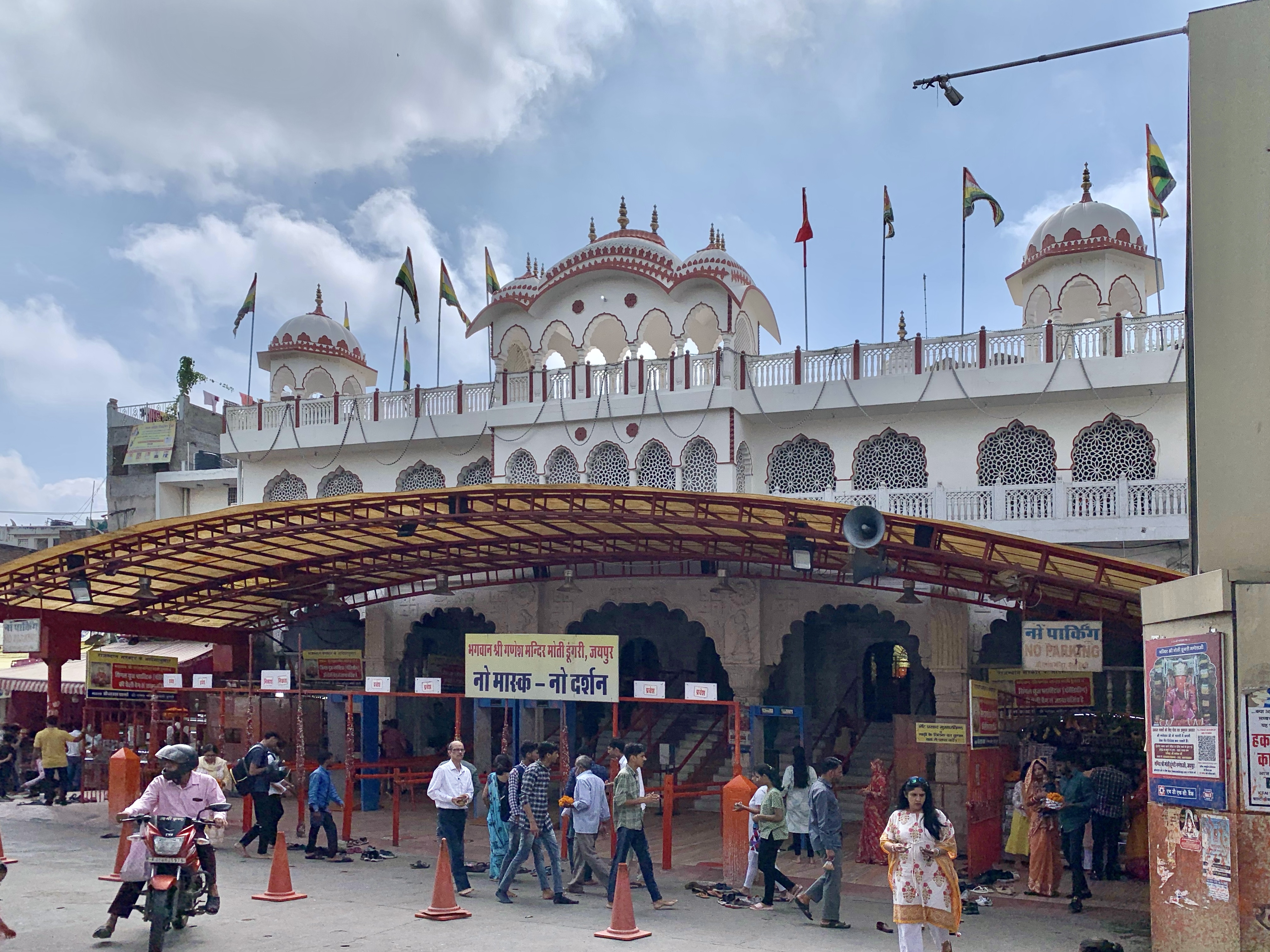
Located at the foot of Moti Dungri hill, close to the Birla Mandir, the Ganesh temple dates to the 18th century. Incredible India and other widely cited temple histories credit Seth Jai Ram Paliwal with its construction in 1761, making it a part of Jaipur's religious landscape for more than 250 years.
A popular legend associated with the temple tells of the Ganesha idol being transported through the region on a bullock cart. It had supposedly been decided that a temple would be built wherever the cart stopped, and when it came to a halt at the foot of Moti Dungri, that became the chosen location.
Like many old temple stories, the legend is part history and part local tradition, but the importance of the temple in modern Jaipur is much easier to see. People visit before beginning important stages of their lives, families seek blessings for auspicious occasions, and newly married couples are among those who come to the temple.
There is also a Jaipur tradition of presenting the first invitation for an important family celebration to Lord Ganesha at Moti Dungri. Weddings are particularly associated with this practice, adding another connection between the temple and marriage traditions in the city.
The temple is busy throughout the year, with Wednesdays considered especially significant for Ganesha worship. Ganesh Chaturthi, however, transforms the area on a completely different scale, with elaborate celebrations and large crowds of devotees.
If you want to experience the mehendi tradition
The most important thing for travellers to understand is that mehendi is not distributed at Moti Dungri every day. The special distribution is associated with Sinjara during the temple's Ganesh Chaturthi celebrations, so visiting the temple at another time of year will be a very different experience.
The exact programme and distribution arrangements can also change from year to year. During the 2026 celebration, for example, the temple announced designated distribution points and arrangements to handle the large number of devotees expected to collect the prasad.
If experiencing the tradition is specifically why you're travelling to Moti Dungri, check the temple's official festival announcements before planning your visit rather than relying on the previous year's date or timings. Ganesh Chaturthi follows the Hindu calendar, so its Gregorian calendar date changes each year.
You should also expect crowds. This is not the kind of occasion where you arrive, spend ten quiet minutes inside the temple and leave. Major festival days can involve long queues, traffic restrictions and large numbers of people moving through the surrounding area. Dress appropriately for a temple visit, carry as little as possible, and follow the directions of temple staff and local authorities.
If you are more interested in seeing Moti Dungri itself than participating in the festival, visiting on a regular day will give you a calmer experience and more time to observe the temple.
Its location also makes it relatively easy to combine with other places in Jaipur. Birla Mandir sits nearby, while attractions such as Albert Hall Museum and the gardens around central Jaipur can fit comfortably into the same part of an itinerary.
A different way to discover Jaipur
It would be easy to describe Moti Dungri Ganesh Temple as another stop on a Jaipur sightseeing list. You could visit the temple, see the architecture, take in the surroundings and move on to the next attraction.
But the annual mehendi tradition tells you considerably more about the city.
Mehendi grown around Sojat travels across Rajasthan to Jaipur in quantities measured in tonnes. At Moti Dungri it becomes part of a religious offering before being divided among thousands of people, many of whom carry a small amount home with a very personal hope attached to it.
For one person, it may simply be prasad from a temple their family has visited for generations. For another, it may be something their parents travelled across Rajasthan to collect. For someone hoping to get married, it may represent a prayer for the next chapter of their life.
None of those experiences appear on the usual list of Jaipur's monuments.
And that is precisely why traditions like the Moti Dungri mehendi distribution are worth knowing about. Jaipur isn't only a city to be seen through its forts and palaces. Sometimes, understanding it means noticing what thousands of local people are queuing for, and asking why.
Have a travel story to share? Write for us