Bagh Caves: India's Forgotten Buddhist Paintings
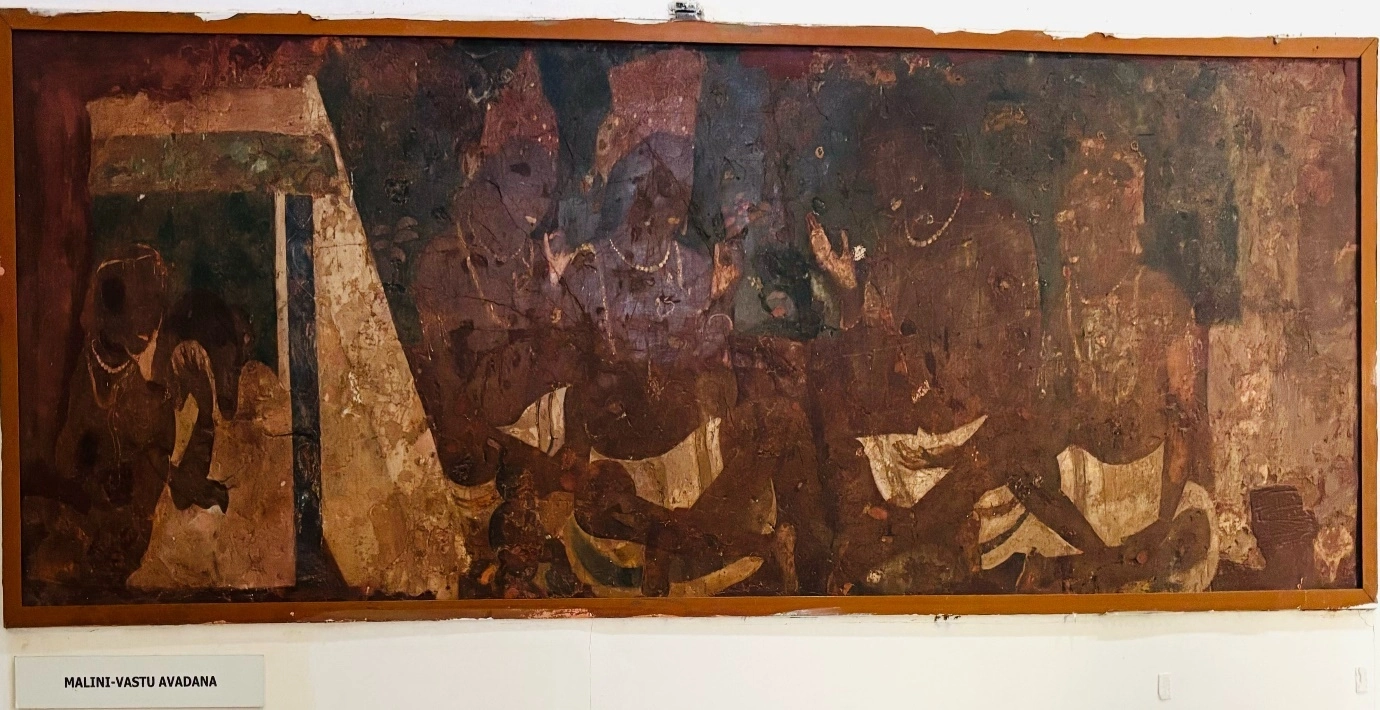
Photo: Sandip Mukherjee, Used with permission
A journey into a little-known treasure of ancient Indian art and the remarkable contribution of famed Bengal School artist Asit Kumar Haldar. A visit to the Bagh Caves in Madhya Pradesh.
There are places in India that are celebrated across the world, and then there are places that seem to have escaped our collective imagination. The Bagh Caves in Madhya Pradesh belong rather unfairly to the latter category. While Ajanta and Ellora attract thousands of visitors, art historians, students and tourists, this extraordinary group of ancient Buddhist caves, with their remnants of some of India's finest tempera paintings, remains relatively unknown to the travelling public.
And yet, Bagh has a story that deserves to be told.
For me, the destination carried an additional significance. My maternal grandfather, Asit Kumar Haldar, one of the early exponents of the Bengal School of Art, had travelled to these caves in the early twentieth century. He was the first and I believe the only young artist to visit the caves in 1917 and returned in 1921 as part of a commissioned expedition to document and copy the ancient paintings. These journeys were particularly important in recording a heritage that was already beginning to disappear. His association with Ajanta was also well established, but Bagh remained a less familiar but an important chapter of his artistic journey.
More than a century later, the opportunity to visit this remarkable site finally presented itself to us during a journey through Madhya Pradesh, to see first-hand the caves which by the way have just been put up for UNESCO listing (2026).
And what a discovery it turned out to be!
A Buddhist world hidden in the Vindhyas
Located in the Dhar district of western Madhya Pradesh, near the small village of Bagh, these caves are carved into the sandstone cliffs overlooking the Baghini River, a tributary of the Narmada.
The caves date broadly from the fourth to the sixth centuries CE, a period associated with the Gupta and post-Gupta eras, when Indian art, architecture, sculpture and learning were flourishing. Nine caves are traditionally identified, although only five are now accessible to visitors, the others having suffered extensive structural damage.
These were not ordinary caves but carefully excavated Buddhist monasteries, known as viharas. They provided accommodation for monks, spaces for meditation and study, and places of worship. Their halls, pillars, residential cells and sculpted interiors give us an idea of how an organised Buddhist monastic community once functioned here.
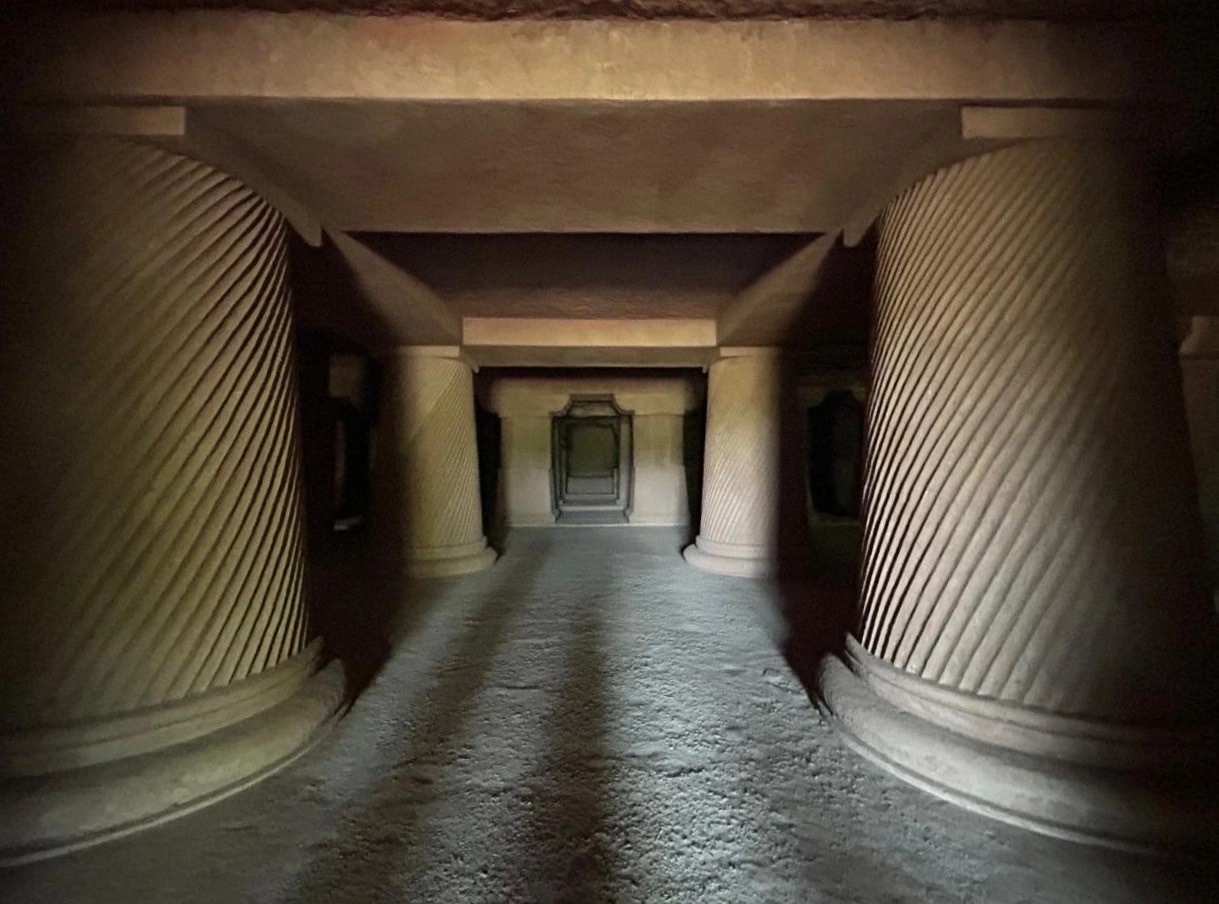
The pillared hall of a rock-cut vihara at the Bagh Caves, Madhya Pradesh.
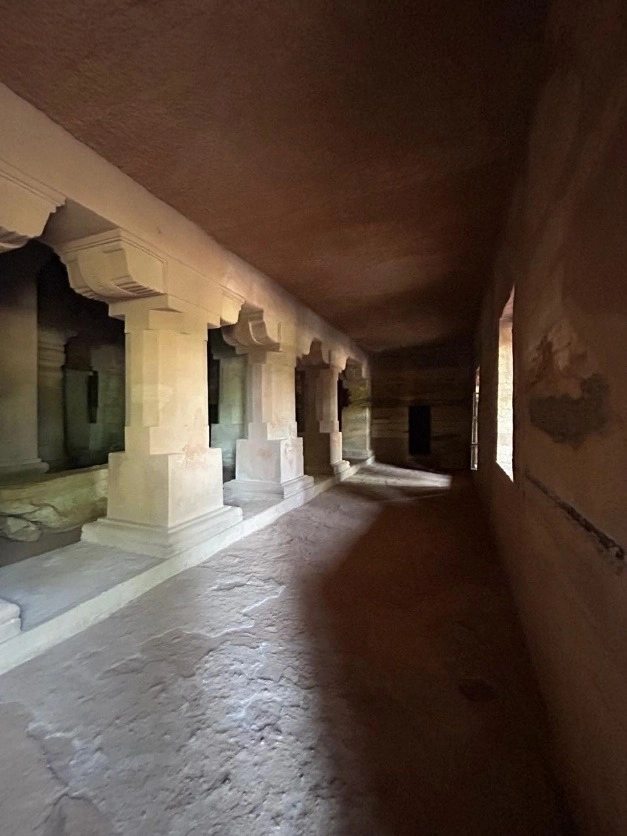
A colonnaded corridor inside one of the Bagh cave monasteries.
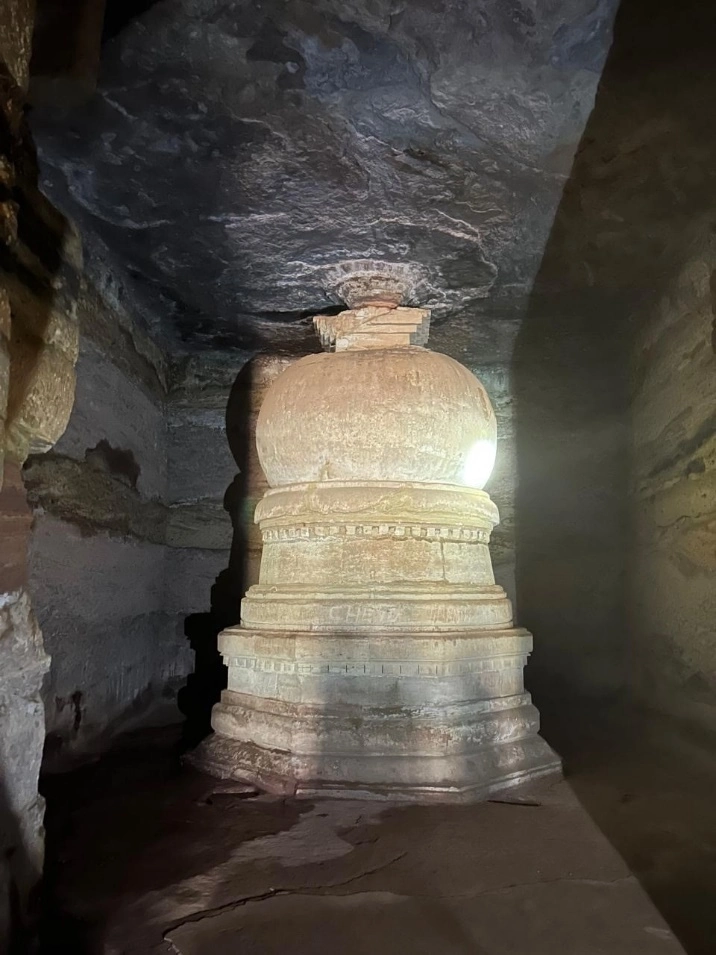
A stupa in a cave shrine at the Bagh Caves, Madhya Pradesh.
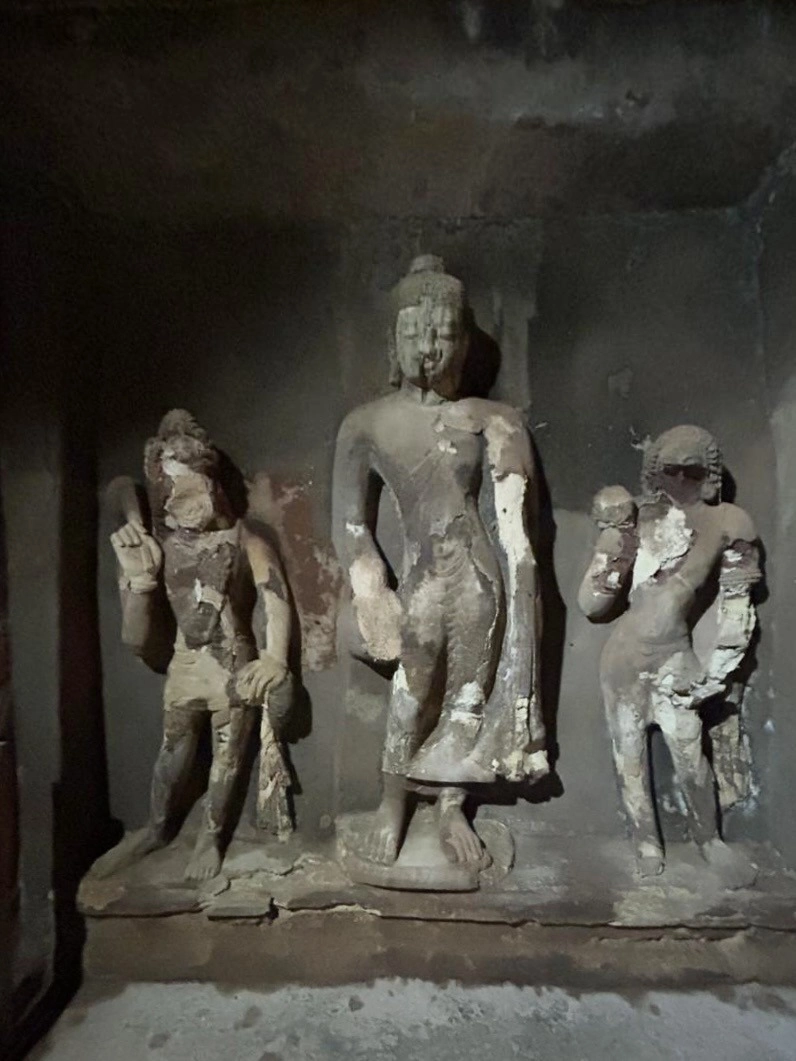
A Buddha figure with two attendant sculptures in a cave shrine at Bagh.
Cave No. 4, popularly known as the Rang Mahal or Palace of Colours, is particularly significant for its painted decoration.
One cannot help wondering what this landscape must have looked like 1,500 to 1,700 years ago. The monks, teachers, visiting scholars and artists would have occupied these hillsides, with the monasteries functioning as centres of religious and cultural activity. Today, the silence is almost complete, interrupted occasionally by the sound of the river or the movement of a visitor.
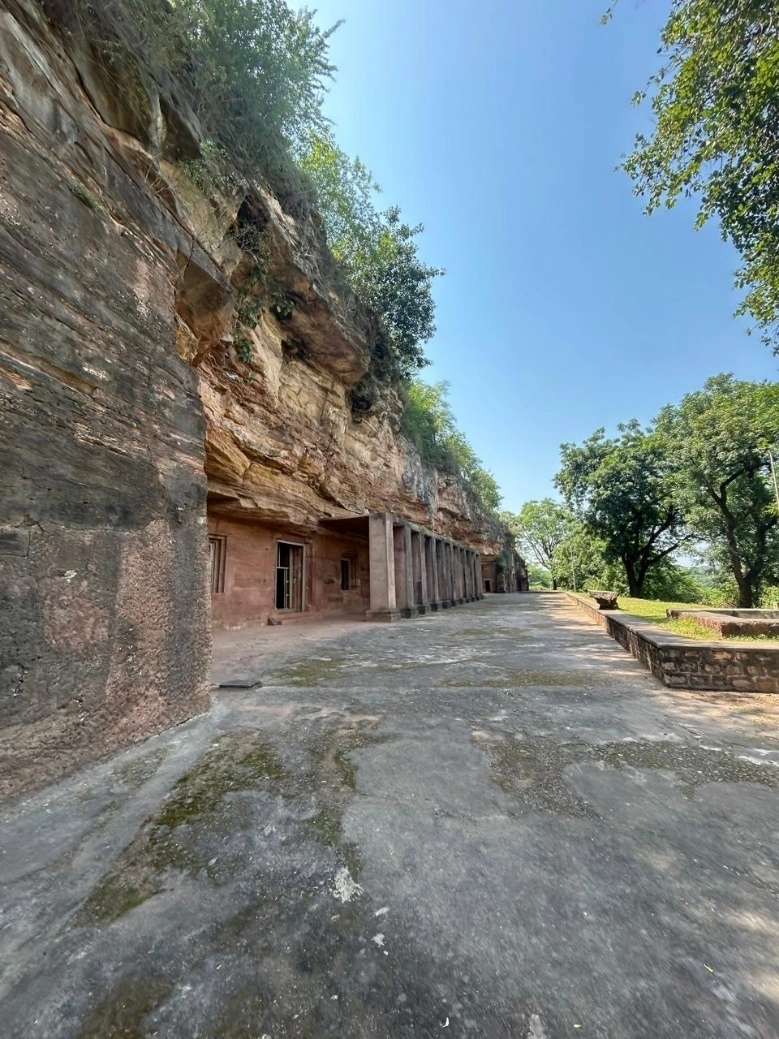
The sandstone cave facade at Bagh, along the path beside the cliffs.
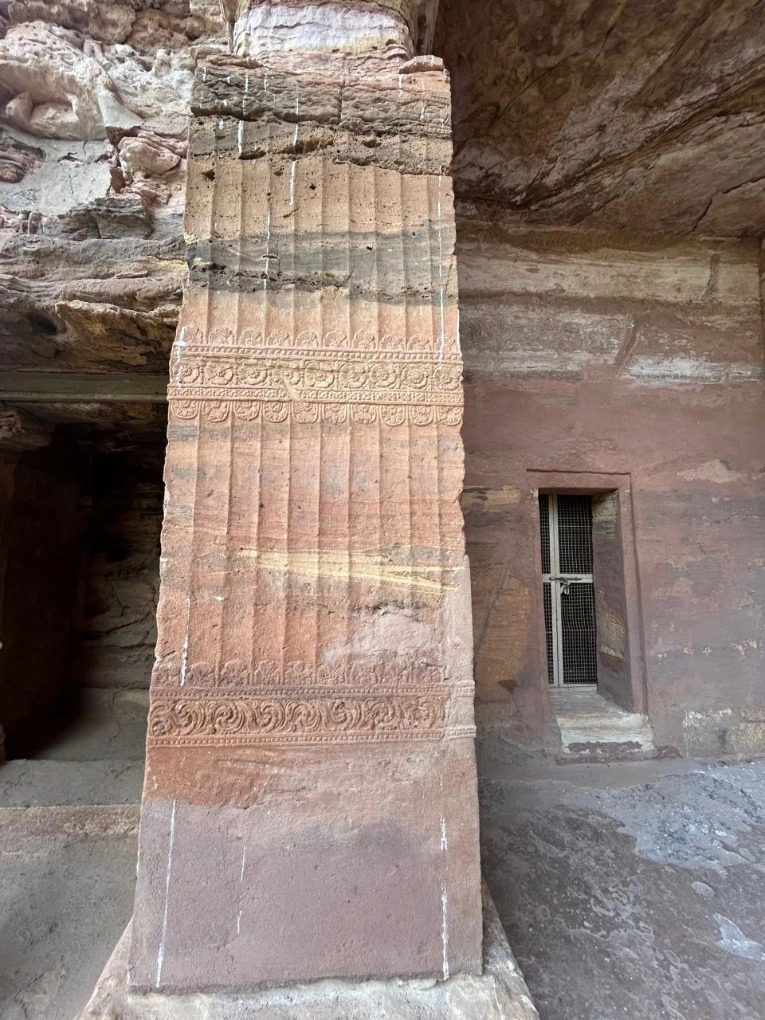
A carved sandstone pillar at the entrance of a Bagh cave.
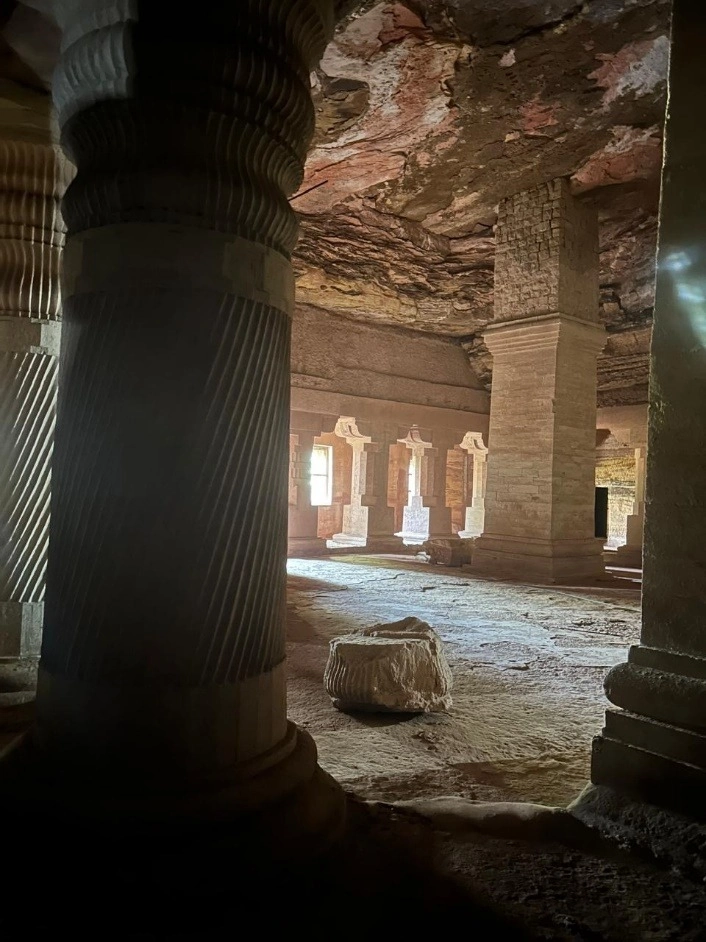
Interior of a Bagh vihara, with spiral-fluted pillars and light from the outer wall.
The modern history of the caves began with their discovery by Captain F. Dangerfield in 1818, although local communities would undoubtedly have known of their existence much earlier.
The paintings: forgotten masterpieces
The real attraction of Bagh lies in its temperas.
Although much of the original artwork has been lost to time, humidity, weathering and the deterioration of the sandstone and plaster, the surviving fragments reveal an exceptionally accomplished school of painting.
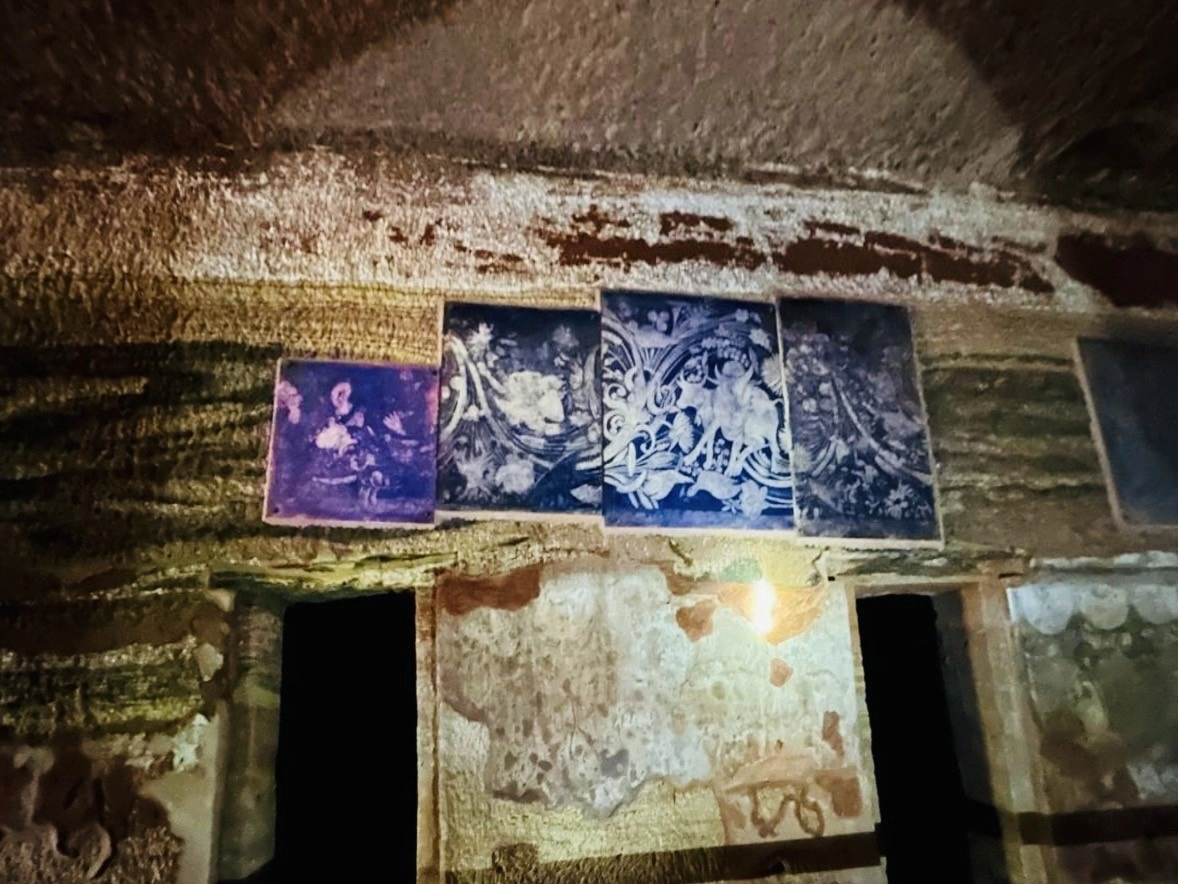
Surviving tempera fragments on a cave wall at the Bagh Caves.
Unlike the popular perception that ancient Buddhist paintings were entirely religious in character, Bagh presents a much wider visual world. Its paintings include human figures, musicians, dancers, attendants, processions and scenes of courtly life. Their costumes, ornaments, gestures and expressions provide fascinating glimpses into the social and cultural life of ancient India.
The figures are particularly striking. They possess movement, grace and a remarkable sense of proportion. Strong outlines define the bodies, while the use of warm reds, yellows, earthy browns and other natural pigments gives the compositions depth and character.
The technique is generally described as tempera painting. The artists first prepared the rough sandstone surfaces with a thick layer of mud-based plaster, followed by a finer lime-based coating. Pigments mixed with suitable binding materials were then applied to this prepared surface.
This was an elaborate process, requiring considerable skill and an understanding of materials, surface preparation and colour application.
What makes Bagh especially fascinating is that its paintings are not merely religious illustrations. They communicate human emotion and activity. One almost senses the movement of a procession, the rhythm of musicians and the presence of a vibrant society beyond the monastery walls.
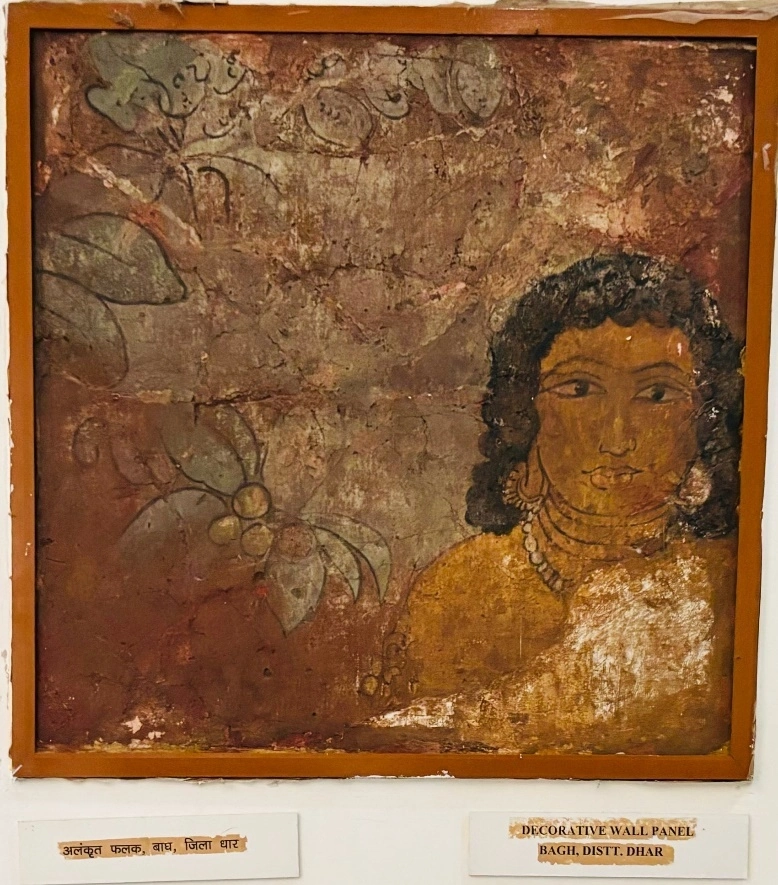
A painted figure from a mural panel at the ASI site museum, Bagh.
Bagh and Ajanta: cousins, not copies
It is impossible to discuss Bagh without bringing Ajanta into the conversation.
Both belong to the great tradition of ancient Indian Buddhist painting and share several artistic characteristics, including prepared plaster surfaces, mineral pigments, expressive human figures and sophisticated compositions.
Ajanta, developed over several centuries from around the second century BCE to the sixth century CE, is particularly celebrated for its Jataka tales, the life of Buddha and its magnificent Bodhisattva representations.
Bagh, on the other hand, has a distinct personality. Its figures are often more animated, with a particularly engaging representation of musicians, dancers, attendants and processions.
The two sites reflect a shared artistic culture, but Bagh should never be regarded as a lesser imitation of Ajanta. It represents an independent and important regional expression of classical Indian art.
Indeed, the relationship between these two centres raises interesting questions about the movement of artistic ideas, Buddhist teachers, craftsmen and patrons across central and western India. There is, however, no conclusive evidence of a wholesale migration of monks from Ajanta to Bagh.
Asit Kumar Haldar: the artist who recorded a disappearing heritage
The modern rediscovery and documentation of Bagh's paintings owe much to the work of early twentieth-century Indian artists.
Among the most significant was Asit Kumar Haldar, who first visited Bagh in February 1917 and returned in January 1921. The latter visit formed part of a commissioned effort, associated with the Gwalior State authorities, to record and reproduce the murals. Other artists worked alongside, including Nandalal Bose and Surendranath Kar.
These were not easy assignments. The caves were remote, access was difficult and the paintings were already in a fragile condition. The artists had to study the surviving compositions closely and painstakingly reproduce what they could see.
Their copies became invaluable records of paintings that have since deteriorated further or disappeared altogether.
Haldar subsequently published The Buddhist Caves of Bagh in the October 1923 issue of The Burlington Magazine for Connoisseurs, bringing scholarly attention to this relatively neglected artistic heritage.
His work at Ajanta and Bagh was indeed part of a larger movement among Indian artists to rediscover the country's classical artistic traditions. It was also an important influence on the Bengal School, which sought to develop a modern Indian visual language rooted in indigenous artistic and cultural inheritance.
For the family, therefore, visiting Bagh was not simply another excursion to an archaeological site. It was an opportunity to see, at first hand, a place that had formed part of an artist's life and work more than a century earlier.
Where can one see the paintings today?
The caves themselves remain the first destination, although visitors should not expect to see the extensive temperas in their original splendour. Much of the decoration has vanished, and what survives is often fragmentary.
The fourth cave, Rang Mahal, is particularly important. Some reproductions displayed within the complex help visitors understand how the original painted surfaces might once have appeared.
Look out for representations associated with the Mahavastu-Avadana, the Vidura Pandita Jataka, the Licchavi horse procession and the Miracle of Buddha.
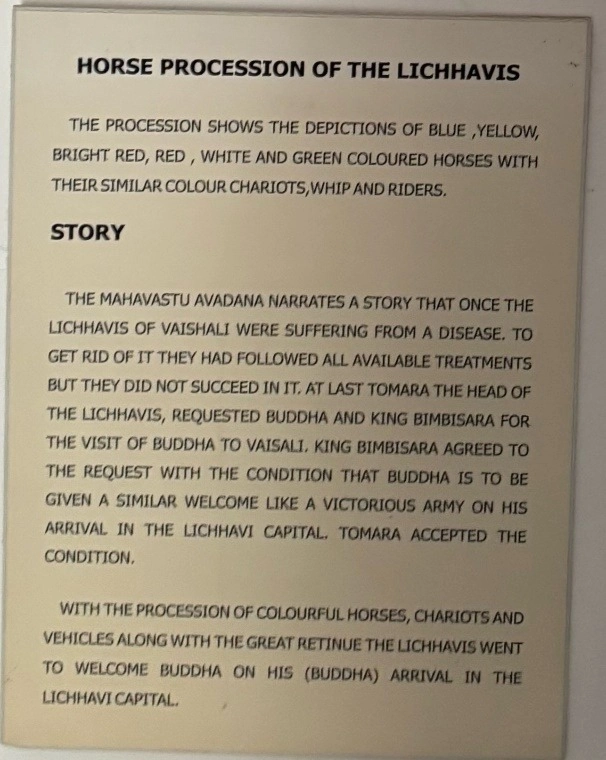
An ASI site museum panel describing the Horse Procession of the Lichhavis.
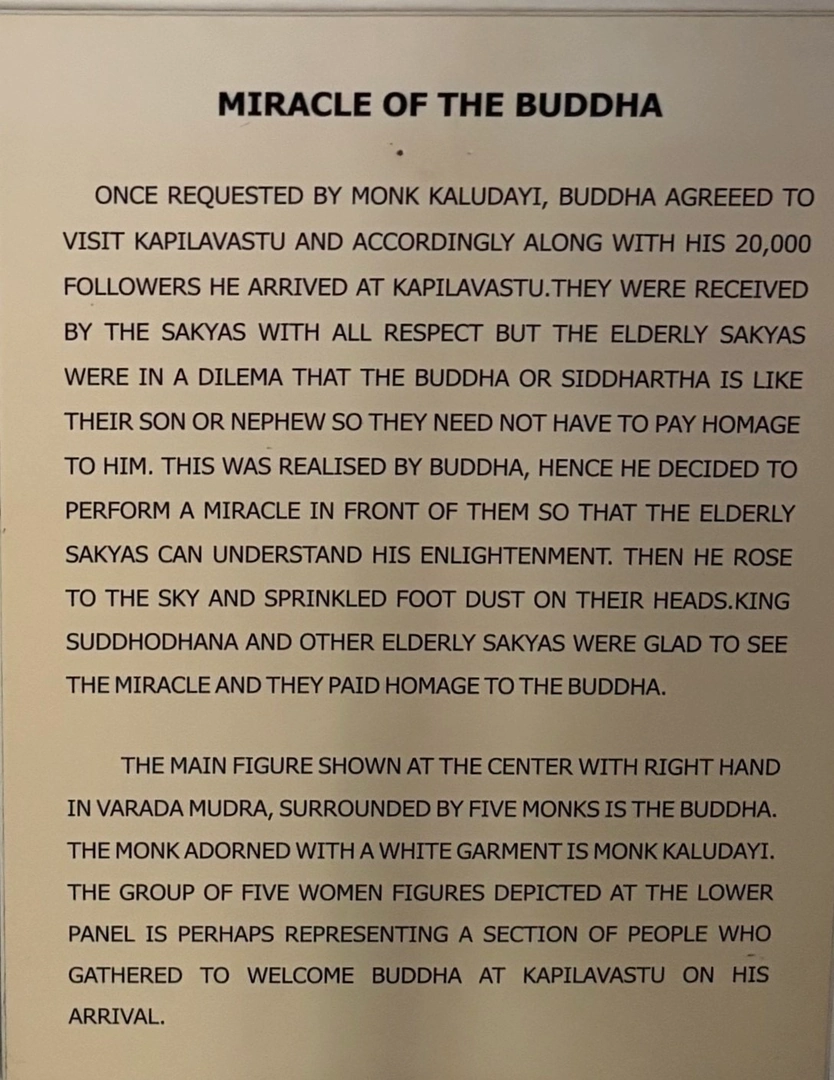
An ASI site museum panel describing the Miracle of the Buddha.
There is also a small site museum with three galleries, which adds considerably to the visit.
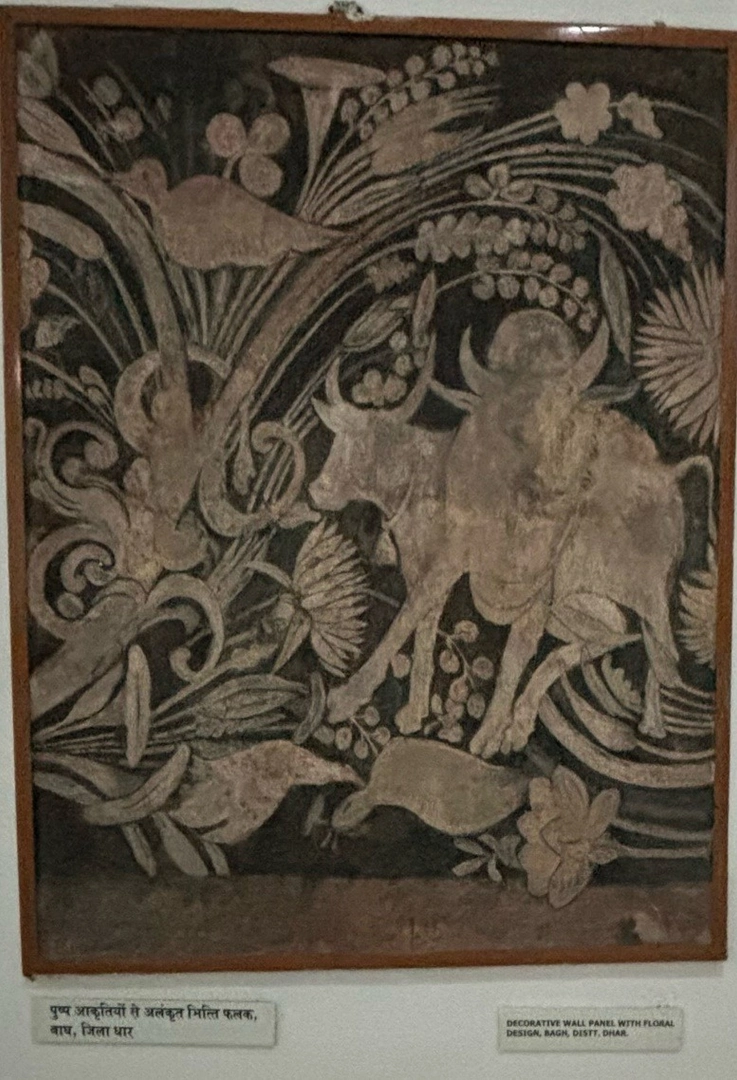
A decorative wall panel with cattle, birds and floral motifs, displayed at the ASI site museum, Bagh.
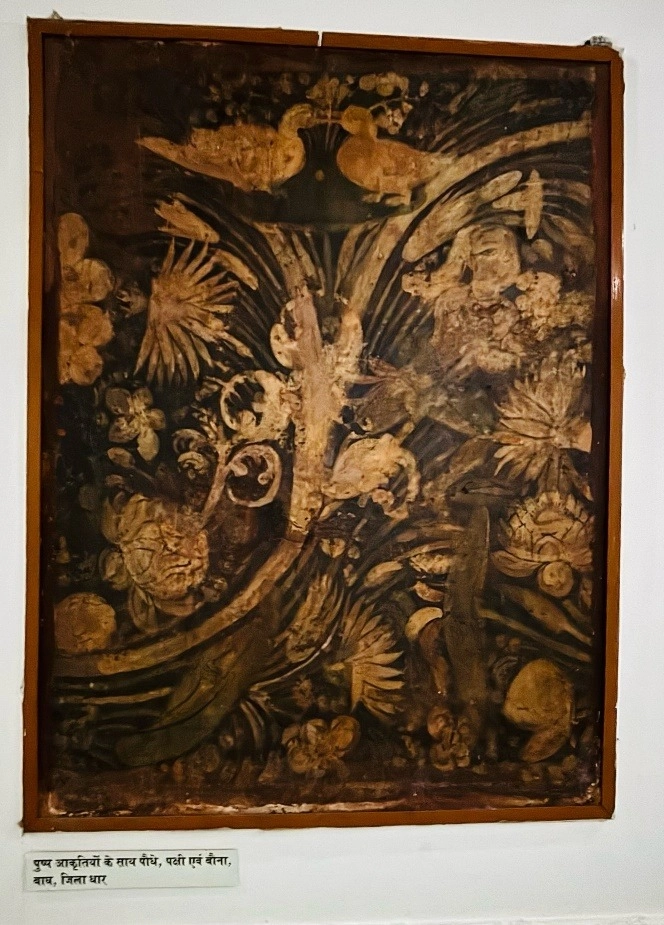
A decorative wall panel with birds and floral motifs, displayed at the ASI site museum, Bagh.
For those interested in studying the paintings in greater detail, the State Museum in Bhopal (on its Level 2 Gallery) has an important collection of Bagh reproductions and related material. The Gwalior Archaeological Museum is also associated with a substantial collection of copies made during the early documentation campaigns. These reproductions are particularly valuable because they preserve details of the original compositions that are no longer easily visible at the caves.
It is worth remembering that these are historical reproductions, not surviving original artwork. Their importance lies precisely in the visual record they have preserved.
The journey: getting to Bagh
One of the reasons Bagh remains relatively unknown is its location. It is not a destination one happens to pass while travelling between major cities. A little planning is essential.
From Mandu: This is arguably the most convenient way to visit Bagh. Madhya Pradesh Tourism lists the caves as an excursion of approximately 90 km from Mandu. Depending on the route taken and road conditions, allow roughly 2½ to 3 hours each way. The route can be planned through the Dhar region, with the final approach passing through rural countryside and the Bagh area.
From Indore: Indore is the nearest major airport and an important railway gateway. The road distance is approximately 150 - 160 km, depending on the route, and a drive of around 3½ to 4 hours is a sensible allowance. A private vehicle with a driver is the most practical arrangement.
The Dhar - Bagh Road connection is another option, particularly for those combining a visit with Dhar Fort or other heritage destinations.
Public transport connections to the caves are limited and are not particularly convenient for a visitor on a fixed schedule. A pre-arranged car is strongly recommended.
Here is an important practical point: Bagh is a remote destination. Do not expect hotels, good restaurants, cafés or reliable tourist facilities in the immediate vicinity of the caves. Accommodation options are better arranged in Mandu, Dhar or Indore. There is also no reason to assume that refreshments or a proper meal will be readily available at the site.
Carry drinking water, some snacks, essential medicines and anything else you may need. It is advisable to start early, spend two to three hours exploring the caves and museum, and return to Mandu or Dhar by late afternoon. If travelling from Indore, begin particularly early and plan the return journey in daylight.
Comfortable walking shoes are useful, as some cave interiors are dimly lit and the surfaces may be uneven. A torch can also be helpful. Request the ASI staff on duty to assist and they will gladly do so – acting quite as a guide too. Fridays are closed days for the ASI Museum site, please do remember. Do check current access arrangements and opening hours before travelling.
A destination worth re-discovering
What struck us most about Bagh was the setting and the remarkable sense of tranquillity. The approach to the caves includes a small bridge across the Baghini River, beyond which the sandstone escarpment rises to reveal the ancient monastic complex.
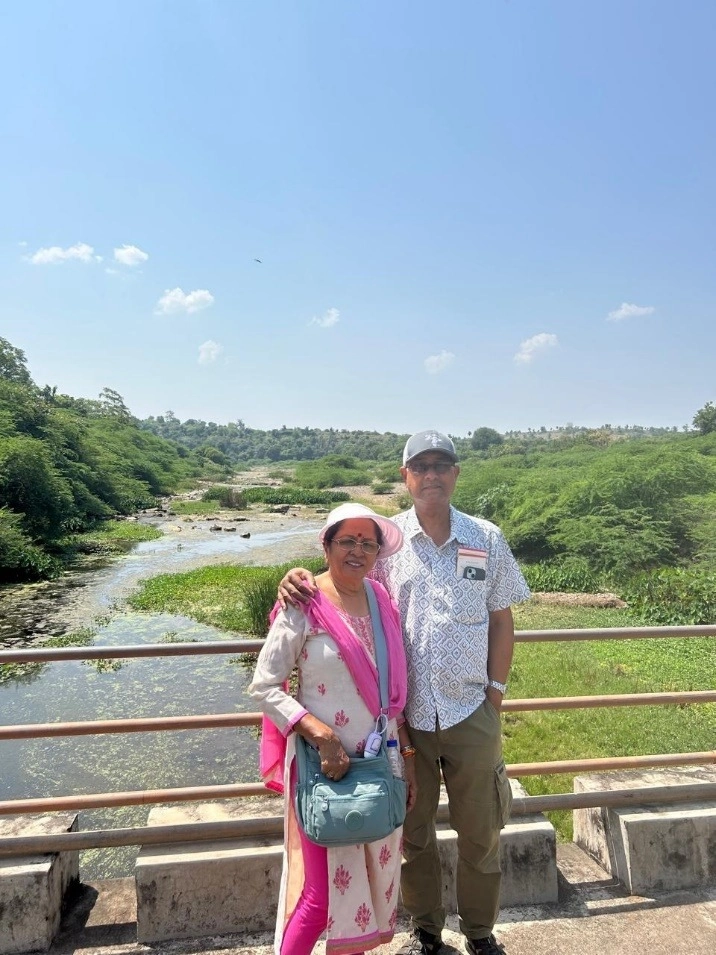
The author and his wife on the bridge over the Baghini River.
The ASI-maintained premises were clean and well looked after. The surrounding landscape, the caves and the small museum together make for a rewarding heritage experience. A little more visitor infrastructure, particularly signages and a modest refreshment facility, would certainly improve the experience.
But perhaps the absence of crowds is also part of Bagh's appeal.
Standing inside these ancient spaces, one begins to imagine the lives of the monks, the artists who prepared the walls, the craftsmen who chiselled the rock, the painters who did the tempera and the patrons who supported this remarkable cultural enterprise. One is also reminded of the countless works of art across India that have survived, sometimes barely, because a few individuals recognised their importance and made an effort to record them.
Bagh is one such place.
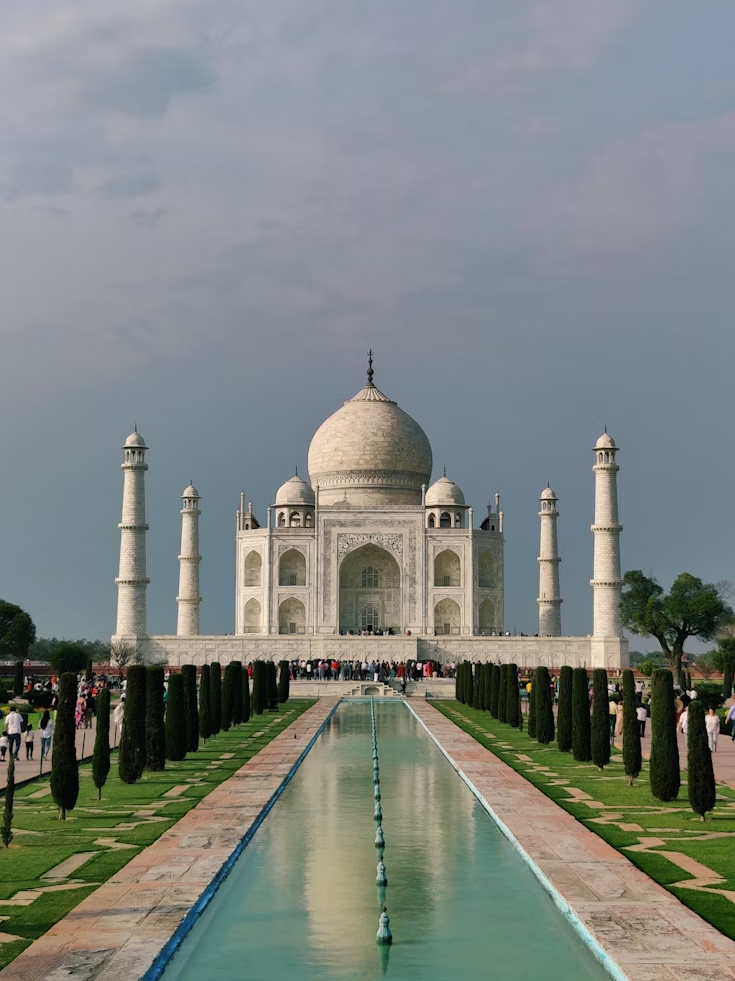
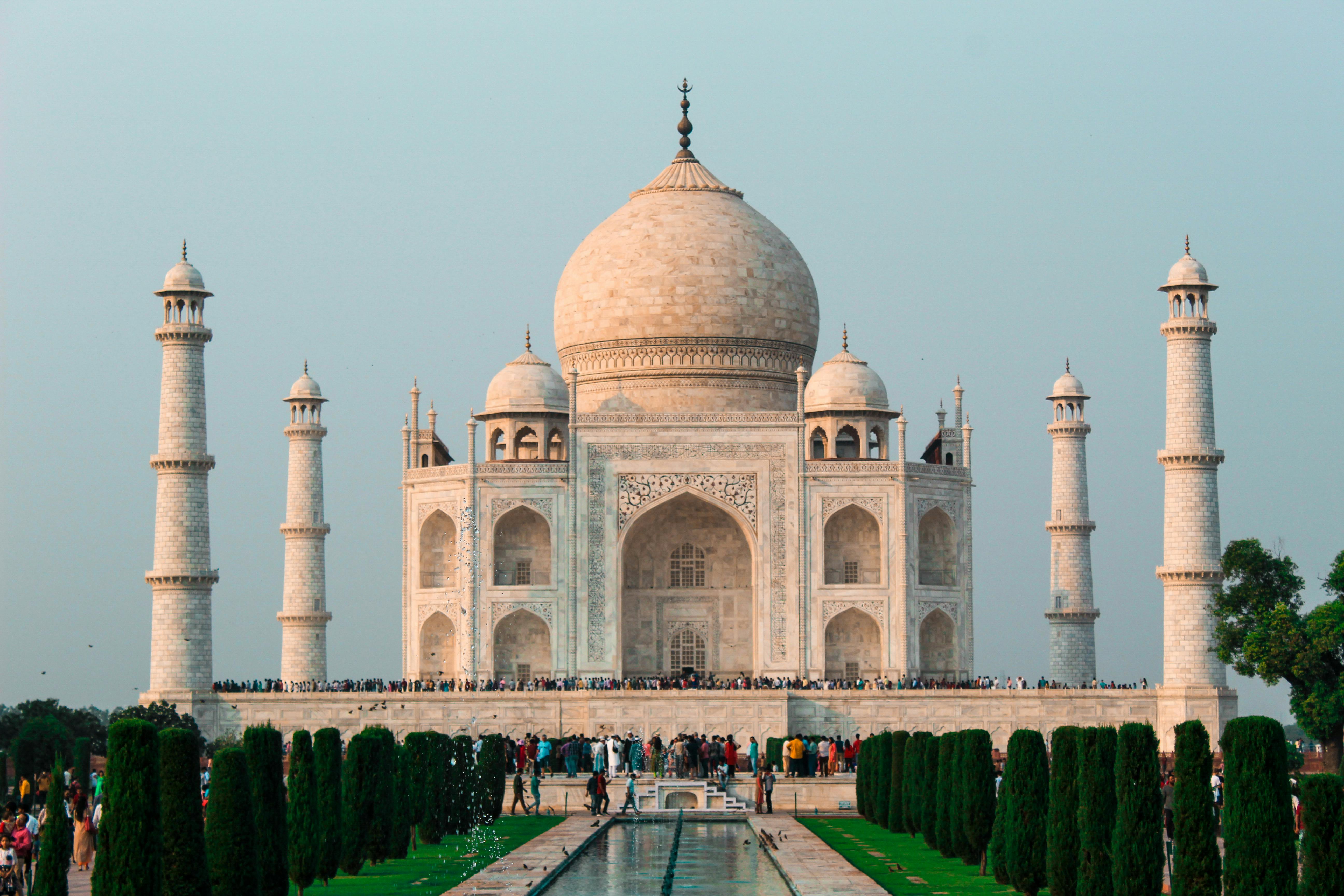
It may not offer the grandeur of the Taj Mahal or the scale of Ajanta, but it offers something equally precious: an intimate encounter with an extraordinary chapter of India's artistic past.
So, the next time you are planning a visit to Mandu, Dhar or Indore, do keep a day aside for Bagh. Make the journey, cross the little bridge over the Baghini, walk through the ancient viharas and spend some time with the paintings that once adorned their walls. Bagh remains one of India’s significant early medieval Buddhist painting sites because it preserves a rare, though fragmentary body of Gupta and post Gupta period temperas outside Ajanta.
You may return with more than photographs. You may return with a renewed appreciation of how much of India's extraordinary heritage still awaits discovery. Do visit the galleries of the state museums at Bhopal and Gwalior too when you have time and opportunity - where most of the artwork of these famed temperas today lie.
Dekho Apna Desh!
Sources and historical references
Madhya Pradesh Tourism - Bagh Caves: Official tourism information.
Dhar District Administration - Bagh Caves: History, location, cave architecture, dating and painting techniques.
UNESCO World Heritage Centre - Bagh Cave Paintings: The site's historical and artistic significance and its 2026 Tentative List submission.
Asit Kumar Haldar - MAP Academy, IMPART: His artistic career, Bagh documentation and 1923 Burlington Magazine publication.
Visva-Bharati - Asit Kumar Haldar: Institutional biographical record.
About the Author
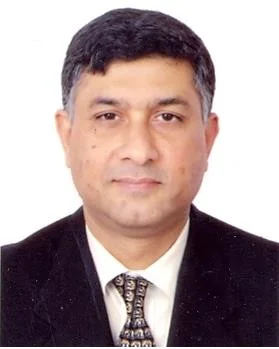
Sandip Mukherjee is a Kolkata-based hospitality consultant, academic and published author. He spent more than two decades with Taj Hotels, where he was Director of Operations and General Manager, and is now Director - Academics at the IIHM Group of Institutions. He and his wife travel often, looking for places in India they feel deserve more visitors.
Read his earlier piece on the Bihar Museum in Patna.
Have a travel story to share? Write for us