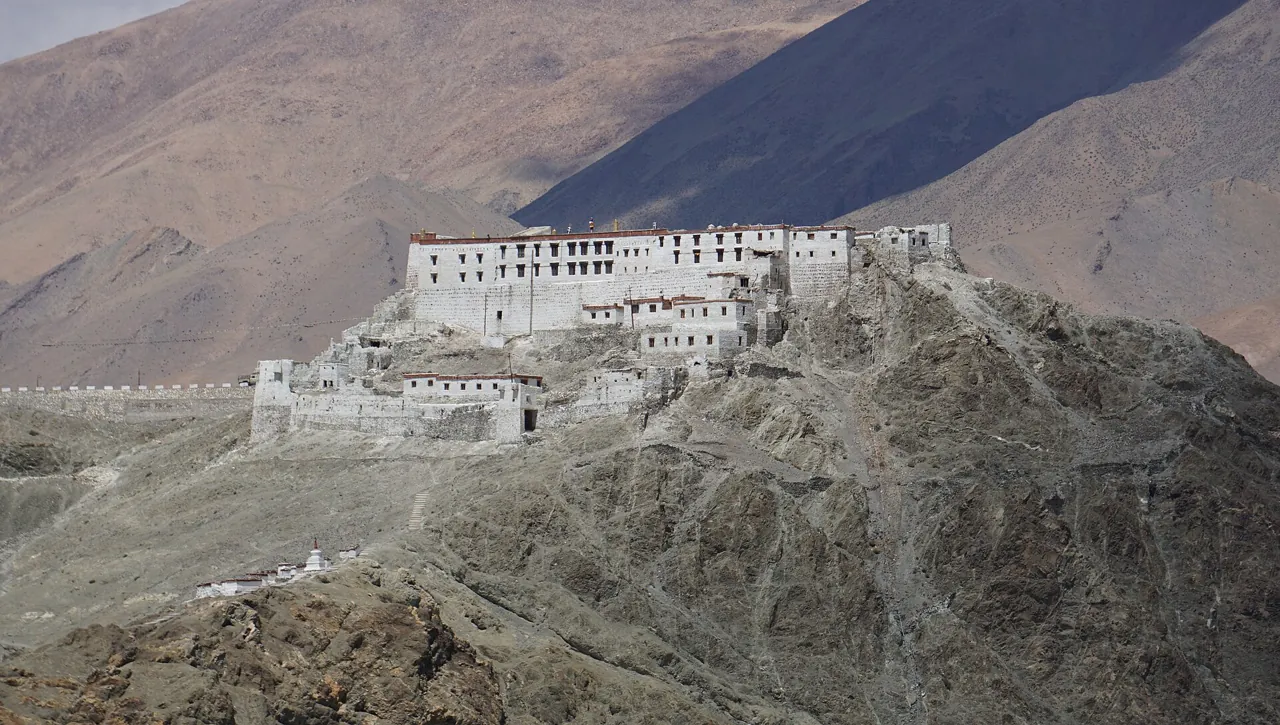
Hanle Monastery on its hill above the Hanle valley
Hanle is a cluster of small hamlets in the Hanle river valley in far south eastern Ladakh, on an old branch of the Ladakh to Tibet trade route. It is home to the Indian Astronomical Observatory of the Indian Institute of Astrophysics, at about 4,500 m one of the highest sites in the world for optical, infrared and gamma ray telescopes. In December 2022 about 1,073 sq km around it, covering the hamlets of Bhok, Khuldo, Shado, Punguk, Naga and the Tibetan refugee settlement, was notified as the Hanle Dark Sky Reserve, India's first. Outdoor lighting and vehicle high beams are restricted, and trained villagers run stargazing sessions with telescopes.
The 17th century Hanle Monastery of the Drukpa Kagyu school stands on a hill above the valley. Hanle also lies inside the Changthang Cold Desert Wildlife Sanctuary and has become the best known place in India to look for the Pallas's cat. Kiang graze the plains, Tibetan argali live in the upper valley, and black-necked cranes nest in the Hanle marshes in summer.
Nights are very cold even in summer, mobile signal is limited and stays are mostly simple homestays. Pick moonless nights for the darkest skies, and keep headlights dipped inside the reserve. Indian visitors need the LAHDC Leh environment fee receipt from lahdclehpermit.in and a photo ID; no Inner Line Permit is required. Rules for foreign nationals are stricter and can change, so check with a registered travel agent in Leh before planning.
- Address: Hanle, Hanle valley, Changthang, Leh district, Ladakh
- Hours: Village, open year round. Summer is best for wildlife; clear, moonless nights are best for stargazing.
- How to Reach: A long drive from Leh, south east along the Indus valley via Upshi, Chumathang and Nyoma. Many travellers combine Hanle with Tso Moriri or Pangong over several days.
Share a quick rating, tip, or photo so the next traveler knows what to expect.