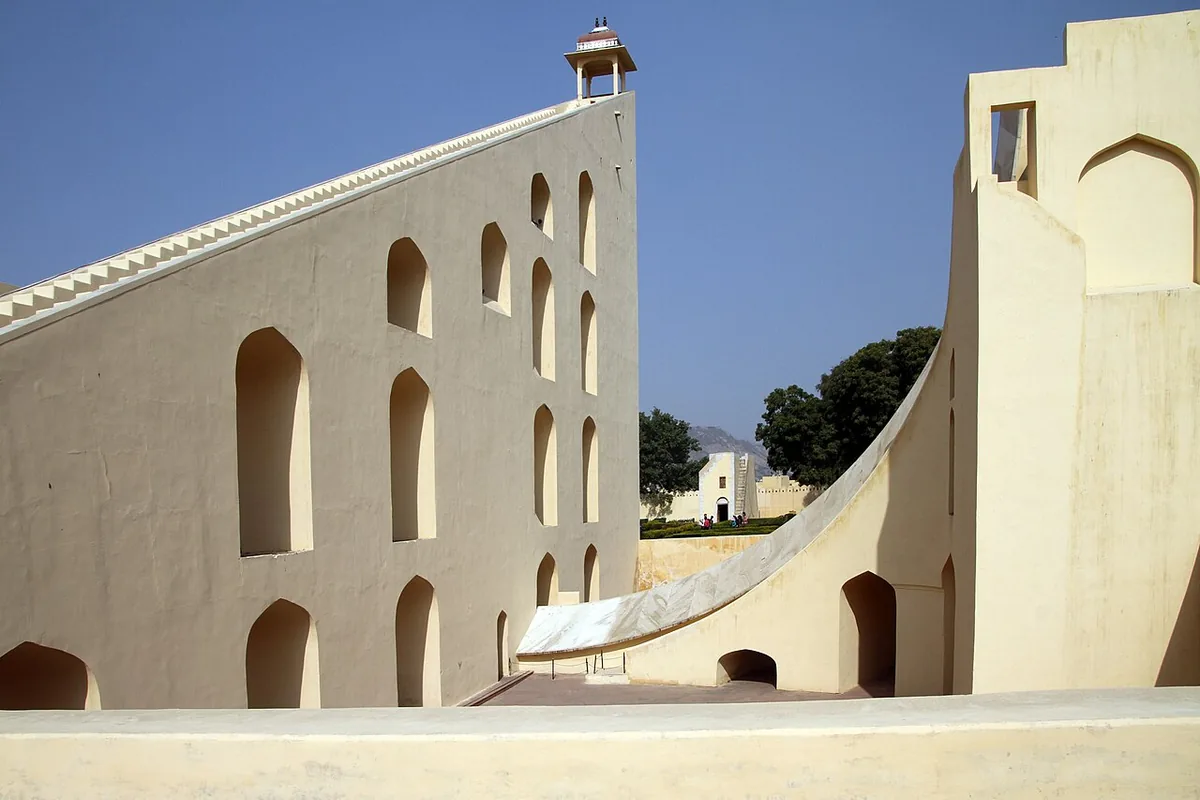
Jantar Mantar, next to City Palace, is the largest of the five observatories Sawai Jai Singh II built in north India. It was completed in 1734 and listed as a UNESCO World Heritage Site in 2010. Its 19 masonry instruments were designed to measure time, track the sun, moon and planets and predict eclipses with the naked eye. The Vrihat Samrat Yantra, a sundial about 27 metres tall, can tell local time to within about two seconds. Other highlights include the Jai Prakash Yantra, a pair of sunken hemispheres that map the sky, and the Ram Yantra, which measures the height and direction of the sun and planets. Hire a guide or use the audio guide, as the instruments make far more sense with someone explaining them, and come on a sunny day to see the sundials at work.
- Address: Tripolia Bazaar, Ramganj, Jaipur, 302002, Rajasthan, India
- Hours: 9:00 AM to 7:00 PM daily, last ticket 6:30 PM (Rajasthan Tourism). Entry (2026 rates): ₹100 Indian, ₹50 Indian student, ₹600 foreign, ₹300 foreign student. Included in the Jaipur composite ticket (₹550 Indian, ₹1,700 foreign; students ₹180 and ₹800), valid for 2 days at 9 state run sites including Amber Fort, Hawa Mahal, Jantar Mantar, Nahargarh Fort, Albert Hall, Isarlat, Vidyadhar Garden and Sisodia Rani Garden.
Share a quick rating, tip, or photo so the next traveler knows what to expect.