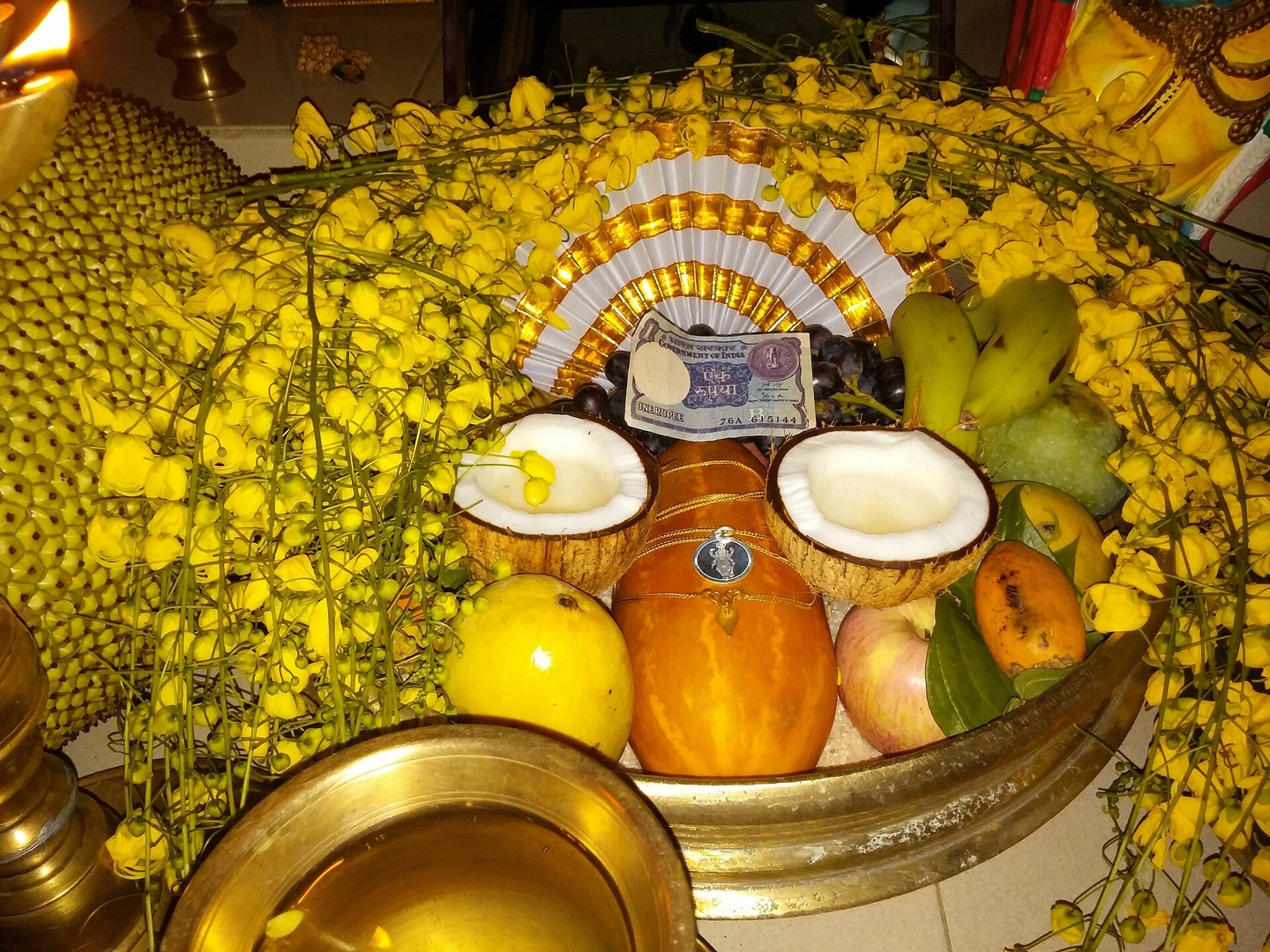
Vishu is not merely a date on a calendar — it is the smell of Kani Konna blossoms arranged beside an oil lamp before dawn, the sound of firecrackers breaking the silence of an April morning, and the warmth of a hand pressing folded notes into a child's palm.
What is Vishu?
Vishu marks the Malayalam New Year, observed when the Sun transitions into Mesha Rashi (Aries) — the astronomical event known as Mesha Sankranti. The word "Vishu" itself comes from Sanskrit, meaning "equal", a reference to the equinox.
The festival is primarily a Keralan celebration, though communities in coastal Karnataka and Tamil border districts observe similar traditions. At its heart, Vishu is about beginnings: the agricultural new year, the first harvest forecast, and the first auspicious sight (kani) that sets the tone for everything that follows.
Unlike Onam, which is a collective public celebration, Vishu is deeply domestic. It begins before sunrise in the family puja room, in near-darkness, with one elder carefully preparing the Vishukkani while everyone else waits — eyes closed — to be led in by hand.
Words you need to know
Malayalam isn't decorative here. These terms are how families actually talk about the festival — at home, in the temple queue, and in the market the week before.
| Vishukkani (വിഷുക്കണി) | The auspicious first-sight arrangement viewed at dawn. Kani means "that which is seen first" — so Vishukkani is literally "the first thing seen on Vishu." The arrangement is assembled the night before by the eldest woman of the household. |
|---|---|
| Kani Konna (കണിക്കൊന്ന) | Indian laburnum (Cassia fistula), the golden-yellow flowering tree whose blossoms are the defining colour of Vishu. No Vishukkani is complete without Kani Konna; families often source it days in advance. It blooms precisely in the Medam heat. |
| Vishukkaineetam (വിഷുക്കൈനീട്ടം) | The gift of money given by elders to children and younger family members on Vishu morning. Kaineettam means "extension of the hand." Amounts traditionally end in 1 (₹11, ₹21, ₹51, ₹101) — signifying a new start that is also a continuation. |
| Vishu Sadhya (വിഷു സദ്യ) | The grand vegetarian feast served on banana leaf. A Vishu Sadhya balances all six tastes: sweet, sour, salty, bitter, pungent, and astringent — representing the spectrum of life's experiences in the year ahead. Avial, sambar, olan, and payasam are essential. |
| Vedikettu (വെടിക്കെട്ട്) | Fireworks. Malayalis are said to burst more firecrackers on Vishu than during Diwali. The crackers begin days before and reach a crescendo on the morning of the 14th — a sensory boundary between the old year and the new. |
Inside a Vishukkani
The Vishukkani is assembled in the puja room on the evening of the 13th, typically around a uruli (a wide bronze vessel) or a large plate. The exact items vary by family and region, but the core elements carry consistent symbolism:
- The eldest woman of the household (or the most senior member) sets up the Vishukkani the night before, covering the arrangement with a cloth
- On Vishu morning, before the rest of the house wakes, she lights the lamp and prepares the room
- Family members are led in with eyes closed, one by one, and opened their eyes only when standing before the Kani
- The first sight — the lamp, the gold, the flowers, the deity — is the Vishukkani moment
- After viewing, Vishukkaineetam is distributed; then the family dresses in new clothes for temple and Sadhya
Vishu Sadhya: what to expect on the leaf
A proper Vishu Sadhya is served on a fresh banana leaf, with over a dozen items arranged in a specific order. The feast is strictly vegetarian and designed to be abundant — generosity at the table on Vishu is said to mirror the abundance of the year to come.
"The Vishukkani seen in the early morning is believed to determine one's luck and prosperity for the entire year. No detail is too small — the angle of the lamp, the freshness of the Kani Konna, the face of the deity turned just so toward the door."A Thiruvananthapuram family, speaking about their preparation ritual
Guruvayur and beyond
The most famous Vishukkani outside a home setting is at Guruvayur Sri Krishna Temple in Thrissur district — one of the most visited temples in India. On Vishu morning, Lord Guruvayurappan is adorned with Kani Konna garlands, gold ornaments, and fresh fruits. Thousands of devotees line up before sunrise to receive the first darshan of the deity as Vishukkani.
- Temple opens in the pre-dawn hours on Vishu — queues form from 2:00–3:00 AM
- Dress code strictly enforced: men in dhoti/mundu with upper cloth; women in saree or half-saree
- Non-Hindus are not permitted inside Guruvayur Temple — this is a firm policy year-round
- Book accommodation in Guruvayur or Thrissur weeks in advance — Vishu is one of the busiest travel periods in Kerala
- Other important Vishu temples: Sabarimala (limited access), Padmanabhaswamy in Thiruvananthapuram, Ettumanoor Mahadeva Temple
How to reach Kerala for Vishu
- Vishu is one of the busiest travel dates in Kerala — book trains, buses, and hotels 4–6 weeks ahead
- Most businesses close on 14 April; plan meals around hotel restaurants or pre-arranged Sadhya bookings
- Fireworks are widespread from the night of 13 April through the morning of 14 April — expect noise
- If you are a guest in a Keralite home, accept Vishukkaineetam graciously — refusing is considered inauspicious
- Carry cash; UPI works well in cities but smaller towns may have limited connectivity on the holiday
- New clothes are traditional — wearing something new on 14 April is a small way to participate in the spirit
Vishu 2026: Key Facts
Whether you wake in a Kerala home with eyes closed waiting to be led to the Kani, or simply taste a Sadhya for the first time seated on the floor with a banana leaf spread before you, Vishu has a way of slowing the world down. It is a festival about looking — at gold, at flowers, at each other — and deciding that the year ahead will be abundant. വിഷു ആശംസകൾ. Happy Vishu.
Explore Kerala on Yatrigo
Plan your Vishu visit with our Kerala city guides — Thrissur, Kochi, Thiruvananthapuram, and more.
Explore Thrissur →