Why Ujjain’s Khade Hanuman Is Drawing Thousands of Visitors
A Simhastha 2028 road project left Khade Hanuman standing near Sati Gate. Faith, failed relocation reports, IIT checks and sudden crowds turned a local shrine into national news.
Ujjain has never needed much help attracting pilgrims. Home to the Mahakaleshwar Jyotirlinga and one of Hinduism's most important pilgrimage cities, it receives visitors throughout the year. But in September 2026, a much smaller religious site near Sati Gate suddenly became one of the most talked-about places in the city.
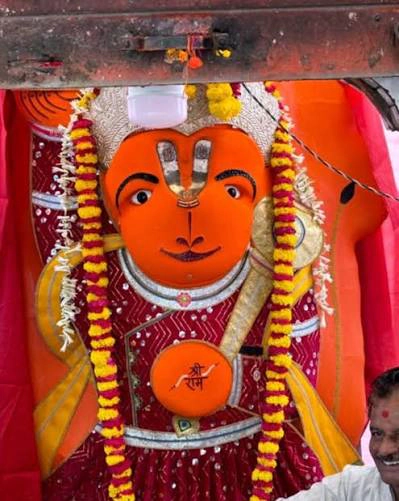
At the centre of the story is Khade Hanuman, a standing idol of Lord Hanuman that found itself directly in the path of a major road-widening project.
The structure surrounding the idol was removed as part of the work, and arrangements were made to shift the idol to another location. What happened next turned what might otherwise have been a local infrastructure issue into a story that travelled across India.
News reports said that repeated efforts involving machinery had failed to move the idol. Videos spread rapidly on social media, devotees began arriving at the site, and many interpreted what had happened as a divine sign. The Ujjain administration later said no machinery or manual relocation attempt had been made, and that further action would wait on scientific and technical assessment.
Officials and experts, meanwhile, faced a more practical question: what exactly is beneath the idol, and how can an old religious structure be moved without damaging it?
Within days, Khade Hanuman had become a meeting point of faith, engineering, history and a city preparing for one of the largest religious gatherings in the world.
It began with a road-widening project
To understand why anyone was trying to move the idol in the first place, you have to look beyond the temple.
Ujjain is undergoing major infrastructure work ahead of Simhastha 2028, the Kumbh gathering held in the city. Roads are being widened and other infrastructure upgraded in preparation for the enormous number of pilgrims expected to arrive.
One of those projects involves the road between Kanthal Chauraha and Chhatri Chowk, where the Khade Hanuman site is located near Sati Gate. Reporting from Ujjain says the stretch is being widened from about 9 metres to around 15 metres (roughly 50 feet), requiring structures along the route to be removed or relocated.
Khade Hanuman was among the religious structures affected.
Authorities had reportedly identified another site for the idol near Tanki Chowk / Chhatri Chowk and prepared a new temple structure there. According to local reporting, the new location had even been decorated in preparation for the idol's arrival.
But the idol remained where it was.
Media coverage described multiple attempts to shift it using equipment and technical assistance, without success. The surrounding temple structure had been removed, leaving the standing Hanuman idol increasingly conspicuous amid the roadworks. By mid-September 2026, reporting also indicated that the proposed relocation had been put on hold pending expert assessment and consultation with devotees and local representatives.
For devotees watching what was happening, this was no longer simply an engineering problem.
Why people began calling it a miracle
Hanuman occupies a particularly important place in Hindu religious tradition, associated with strength, devotion and protection. So when reports emerged that machinery had failed to move the standing idol, a religious interpretation quickly followed.
For many devotees, the explanation was simple: Hanuman did not want to leave.
Videos showing the idol standing at the site spread across Instagram, YouTube and news channels. Stories about failed attempts to relocate it were shared widely, and people who might never previously have heard of Khade Hanuman suddenly knew about the small Ujjain shrine.
Within four days, around 8,000 people reportedly visited the site, with some travelling from outside Madhya Pradesh after learning about it through social media and news coverage. Other reports cited higher daily peaks as crowds continued to build.
The story became even more unusual when a group of langurs was seen around the area. Because monkeys are closely associated with Hanuman in popular religious culture, their appearance was interpreted by some devotees as another sign connected to the events at the temple.
There is no reason to treat the appearance of the animals itself as supernatural, just as there is no established evidence that a divine force prevented the idol from moving. But dismissing the religious interpretation entirely would also miss an important part of the story.
For many of the people travelling there, faith is precisely why the event matters.
So why couldn't the idol be moved?
This is the question that makes Khade Hanuman particularly interesting.
An old stone idol is not necessarily a freestanding object sitting on top of the ground. Its visible portion may represent only part of the structure, with a substantial section extending below ground or connected to an old foundation.
Reports about Khade Hanuman suggested that authorities did not initially know exactly how deeply the idol was embedded or how its underground structure had been constructed.
Rather than continuing to apply force and risk damaging it, officials turned towards technical investigation. Experts, including specialists associated in reporting with IIT Indore, were brought into discussions about examining the structure and determining what lay beneath the surface.
That means the apparently simple question of why the idol would not move may ultimately have an engineering or archaeological explanation.
It doesn't make the story any less interesting.
If anything, it raises another question: how was such a large stone structure installed here in the first place?
How old is Khade Hanuman?
This is also where travellers should be careful with some of the claims circulating online.
Several reports describe the Khade Hanuman idol or temple as being around 170 years old, while other accounts have suggested a much older origin. Some reports have also raised the possibility that the idol's construction could belong to an earlier historical period.
At the moment, those claims should not be treated as a settled archaeological fact.
The age, construction technique and depth of the structure require proper examination before confident conclusions can be drawn. A viral video describing something as a thousand-year-old temple does not make it one.
What can be said more confidently is that Khade Hanuman was already an established local place of worship long before the current road-widening controversy brought it national attention.
For visitors, that distinction matters. The real story is interesting enough without making the history older or more mysterious than the evidence allows.
A small shrine suddenly attracting visitors from across India
Perhaps the most remarkable part of the Khade Hanuman story is how quickly the identity of a place can change.
Until recently, someone planning their first trip to Ujjain would probably have built their itinerary around Mahakaleshwar, the ghats of the Shipra, Kal Bhairav and the city's other established religious sites. Khade Hanuman was primarily a local shrine.
Social media changed that almost overnight.
After videos of the roadworks and the unmoved idol circulated, people began coming specifically to see it. One report documented visitors arriving not only from Madhya Pradesh but also from Gujarat, Maharashtra and Rajasthan.
Some came because they believed they were witnessing a miracle. Others came out of curiosity after seeing the videos online. For local devotees, the sudden attention also strengthened calls for the idol to remain where it had stood for generations.
The result is something increasingly common in Indian travel: a place can become a destination before guidebooks or conventional travel websites have even caught up with it.
Should you visit Khade Hanuman?
If you are already travelling to Ujjain, the site offers an unusual glimpse into something happening in the city right now, but it should not be approached like a newly opened tourist attraction.
Khade Hanuman remains a religious site, and the current surroundings have also been affected by construction and road-widening work. Visitors should expect changing access arrangements, crowds and possible restrictions depending on what authorities decide to do next.
The situation is also developing. Technical assessments and discussions about the future of the idol mean that what you find at the site several weeks or months from now could be different from what visitors are seeing today.
If you do visit, treat the place as you would any active temple or shrine. Avoid obstructing worshippers or ongoing work simply to take photographs or videos, and be particularly careful about repeating unverified claims to local visitors as established facts.
The story is fascinating without needing to choose between declaring it a miracle and trying to disprove someone's faith.
Ujjain is changing before Simhastha 2028
There is also a much bigger story unfolding around Khade Hanuman.
Across Ujjain, preparations for Simhastha 2028 are changing roads, public spaces and infrastructure. The intention is to make it possible for the city to accommodate an extraordinary influx of pilgrims, but large-scale redevelopment in an old religious city inevitably encounters places that carry cultural and spiritual significance.
Khade Hanuman is an unusually visible example of that tension.
From an infrastructure perspective, widening a busy road before millions of additional visitors arrive makes sense. From the perspective of devotees, moving an idol worshipped at the same location for generations is not simply a matter of shifting an obstruction a few metres away.
Both realities exist at the same time.
How Ujjain eventually resolves the Khade Hanuman question may therefore be interesting for reasons far beyond this one temple. The city has two years before Simhastha, and it will repeatedly have to find ways of modernising infrastructure without treating its religious and historical landscape as an empty construction site.
A place most travellers hadn't heard of a few weeks ago
There is something fitting about this story happening in Ujjain.
This is a city where history, mythology and everyday life constantly overlap. Ancient temples sit beside traffic, pilgrims walk through modern markets, and traditions that are centuries old continue in a city undergoing rapid physical change.
Now an old Hanuman idol stands in the middle of that transformation.
Engineers want to understand its foundations. Authorities need to complete a road. Devotees see something divine in its refusal to move. Social media has brought thousands of curious visitors to a shrine many people outside Ujjain had never heard of.
Eventually, there may be a technical explanation for why Khade Hanuman proved so difficult to relocate, and the administration may find a way to preserve or move the idol safely.
But that won't erase what happened around it.
For a few days in September 2026, a road-widening project turned a local Hanuman shrine into one of Ujjain's most talked-about places, showing how quickly faith, infrastructure and the internet can come together to put an unexpected place on India's travel map.
Have a travel story to share? Write for us