Seeing Lucknow Beyond the Nawabi City
Perhaps the easiest way to understand Lucknow is to start with its most famous faces—its nawabs, imambaras, Rumi Darwaza, kebabs, chikankari, and tehzeeb.
Perhaps the easiest way to understand Lucknow is to start with its most famous faces—its nawabs, imambaras, Rumi Darwaza, kebabs, chikankari, and tehzeeb.
The city’s official tourism image is also largely built around these things. Old architecture, Awadhi culture, food, and Nawabi history make up a major part of Lucknow’s identity.
But a city’s identity is not always fully contained in its monuments.
Sometimes, to understand a city, you have to go a little beyond its famous routes—to the markets where people shop every day, to the areas where the city gradually begins to turn into villages, and to the places people visit not to sightsee but to spend their everyday time.
Spending 56 days in Lucknow began to reveal this difference.
This was not a fixed journey. There was no itinerary, nor any compulsion to see a new place every day. The advantage of staying in a city for a long time is that you no longer need to keep looking at it. After a while, it begins to reveal itself.
A City Larger Than Its Monuments
The first picture of Lucknow formed by Charbagh Railway Station is one of architecture. The station building offers an early glimpse of the city’s architectural identity—one that can later be seen on a much larger scale in the buildings of Old Lucknow.
But Lucknow’s story is not only the story of its old buildings.
Visiting the villages around the city became an early part of this journey. Seeing homes, work, and everyday life there was a completely different experience from visiting a tourist attraction.
The landscape around Lucknow is not sharply divided into city and village either. The city’s expansion has brought urban and rural life closer together in many places. Research on Lucknow’s peri-urban areas has also documented this process of changing land use and urban expansion between villages and the city.
But this change can be seen in everyday life before it is recorded in a research paper.
On one side of the road, the city expands; on the other, the village maintains its own pace. People are connected to the city, but their lives are not entirely urban.
Conversations with local people in these areas offered a chance to see Lucknow not as a tourist map, but as a living city.
This was also where the language began to change.
After a while, local words and accents became part of everyday conversation. There may be no more direct sign of becoming immersed in a city.
When a Place Becomes a Routine, Not an Attraction
Staying in a city for a few days and staying there for a long time are two different experiences.
On a short trip, you remember places.
During a long stay, you begin to remember routines.
In Lucknow, one such place was the Amir-ud-Daulah Public Library.
Located in Kaiserbagh, this library was established in 1868. According to the Uttar Pradesh government’s library records, it has a collection of books in various languages, and its building is based on Indo-Islamic architecture.
But the library’s special quality is not just its history.
The experience of sitting there is completely different from visiting one of the city’s monuments.
The old building, the books, the readers, and a brief distance from the city all come together to create a picture of Lucknow different from the one seen in tourism brochures.
You do not always need to visit a city’s most famous places to understand it.
Sometimes, spending two hours in an old library tells you much more.
The same applies to places that gradually become part of your everyday habits.
A flat in Gomti Nagar, which initially was simply a place to stay, became part of everyday life after a few weeks.
Aminabad also became such a place.
How Aminabad Became an Everyday Market Instead of a Tourist Market
It is difficult to separate Aminabad from Lucknow’s food and shopping culture. Official tourism material also lists Chowk and Aminabad among the city’s major food destinations and connects them with local food culture and market life.
But when you observe a market for a long time, another side of it emerges.
It is not just a place to eat.
It is part of people’s everyday needs.
Stores open and close, people shop, routes change, some places remain crowded as usual, and some lanes are suddenly quiet.
A small routine also developed in Aminabad—starting with a pastry from Burma Bakery and ending up at Prakash’s kulfi after wandering around.
A travel guide might not consider this a major thing.
But after living in a city for a long time, these small habits become its most personal memories.
A tourist searches for famous food in a city.
But someone who lives there often discovers a small shop they personally like.
The difference may seem minor, but this is precisely the difference between traveling and living.
The Other City Behind Nawabi Lucknow
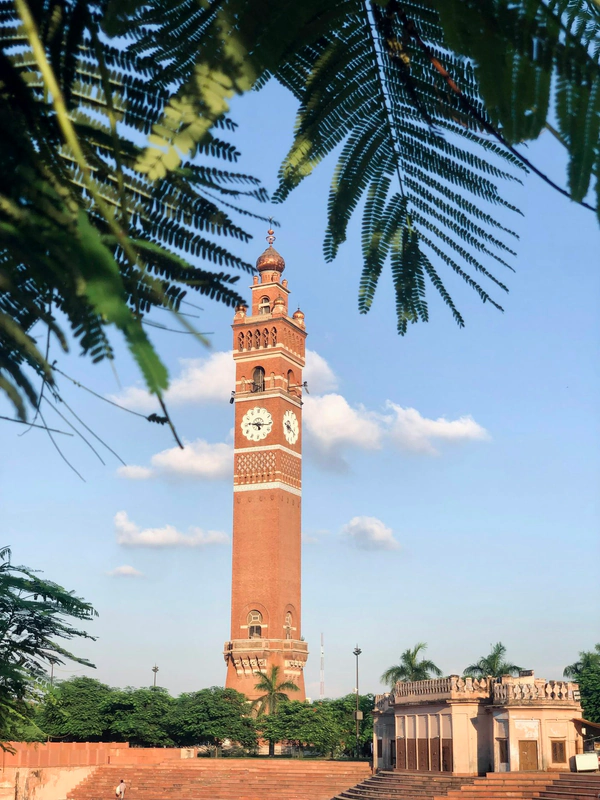
Bara Imambara, Chota Imambara, Rumi Darwaza, Husainabad, and the Clock Tower are the landmarks most readily associated with Lucknow’s historical identity.
Rumi Darwaza is part of the architectural heritage of the eighteenth century that shaped Old Lucknow’s identity. According to Incredible India, it was built around 1784 during the reign of Nawab Asaf-ud-Daula as a famine-relief project.
After seeing these buildings, calling Lucknow the “City of Nawabs” feels entirely natural.
But after living in the city for 56 days, the name begins to feel a little incomplete.
Because Nawabi heritage is Lucknow’s most visible layer—not the whole story.
The moment you step outside these monuments, another Lucknow begins.
The Lucknow of people going to work in the morning.
The Lucknow of e-rickshaws and roads.
Of markets.
Of small shops.
Of people traveling to and from the villages toward the city.
Of those who spend their evenings sitting somewhere.
And of people for whom Lucknow is not a heritage destination, but their everyday city.
What It Means to See a City Slowly
Slow travel is often associated with visiting fewer places.
But staying in a city for a long time is not simply about moving around slowly.
It changes the way you see.
When you do not need to visit a new monument every day, other things about the city begin to appear.
You start seeing the same route again and again.
You begin recognizing a shop.
You start understanding the traffic in a particular area.
You develop your own time for visiting a market.
Evenings in Kukrail became part of the journey in the same way.
Sometimes the library, sometimes Aminabad, sometimes the lanes of Old Lucknow, and sometimes the villages outside the city—together, these places created a Lucknow that does not fit neatly into any tourist itinerary.
Perhaps that is the true beauty of a long stay.
At first, we collect places in a city.
Then, after a certain point, we stop collecting places, and the city’s rhythms begin to appear.
After 56 Days
The day of leaving Lucknow was rainy too.
The train was at 1 a.m. After saying goodbye to friends, the taxi headed toward the station. Along the way, I had a brief conversation with the taxi driver about his work in Lucknow.
It was not a major travel moment.
But perhaps the process of understanding a city is also made up of such small moments.
After 56 days, there was more than just a list of monuments to remember when leaving Lucknow.
There were villages.
An old library.
The lanes of Aminabad.
A small routine formed between a pastry and a kulfi.
Evenings in Kukrail.
And the roads that no longer felt unfamiliar.
At first, Lucknow was a city that had to be explored.
After 56 days, it had become a city that no longer needed to be merely explored.
It had been seen—in its famous buildings as well as in its ordinary life.
Lucknow’s Nawabi heritage may be its most visible identity, but the city’s whole story does not end there.
Beyond it lies another Lucknow—perhaps less spectacular than its monuments, but far more alive in everyday life.
Perhaps, to truly see a city, you do not need more places; you need a little more time.
About the Author
Jignesh Sharma is an entrepreneur, artist, writer, filmmaker and full-time traveler. More of his writing is on Substack, and he is on LinkedIn.
Have a travel story to share? Write for us