Padharo Mhare Desh: The Unseen Rajasthan
Submitted to Yatrigo by the author, Dev Sancheti. Original article on devsancheti.substack.com.
A ride through the streets of Rajasthan.
Most of you already know the Rajasthan everyone talks about. The palaces, forts, deserts, camels, and the reels of Udaipur, Jaipur, and other tourist spots. But that's not the Rajasthan I will take you through in this read. I will take you to the streets of villages, traditions, culture, etc. Now, I wasn't born here, nor did I grow up here. Yet, I am proud to call this heritage state my native one. It's where my family is from, where my roots are, and where my old ancestral house stands.
I frequently visit the big house where once my grandparents lived, whose walls have seen my childhood memories.
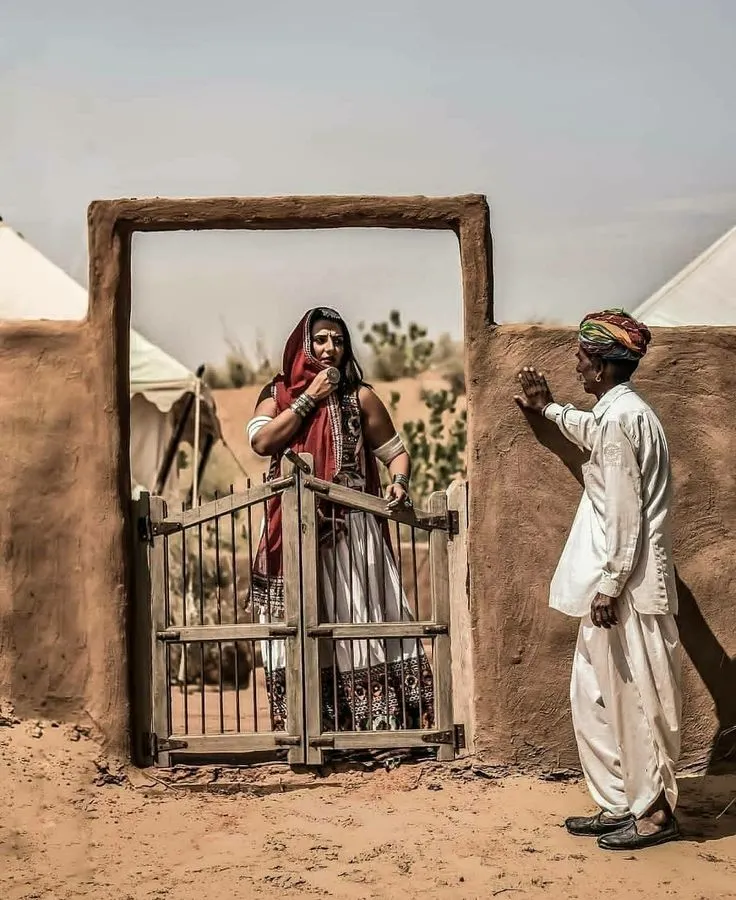
You know those turban-clad men with moustaches (yes, the ones you must have seen in the movies, with red round pagdi and white dresses) sitting on the verandahs of their houses, looking all dangerous. They will stare at you if you don't seem familiar, and you would definitely feel awkward. But, the moment you approach them with a "Khamma Ghani", they will become as friendly as your friend.
They will gladly help you out with directions, tell you history, pull out a charpai for you to sit on, and even offer you chai (chai is a go-to drink there). These men weren't judging you, you just happened to be an interesting person for them, someone who doesn't come into their sight regularly.
And now the women. What I found fascinating about the women of certain communities is their fashion. Most of these women wear colourful backless or deep-neck blouses while also covering their hair with a dupatta (odhni). It seems ironic, but kind of good also? Somewhere along the way, showing skin has become something to judge, but here, backless blouses are just...normal. They are worn with confidence without anyone making a fuss about it. I love that the tradition has survived for generations.
Cultural clothing doesn't fit the idea of what's modest or bold, it's just culture being culture.
One of the captivating things I see during my staycation in Rajasthan is lunches in the form of prasad in temples on occasions or on certain tithis. There is no fancy buffet, it's just classic dal bati churma, as authentic as you can find. You sit in a long line, one person would bring the thali, the other would get a bowl, and finally a glass would be placed alongside it. The serving is almost like a ritual in itself. First comes the churma, while you finish it, someone will come with lime and salt.
The batis would land on your plates. As you smash them open, a guy would appear with mirchi ka thecha, followed by pouring hot dal with a garlic flavour. And then, ofcourse, a volunteer would fill the glasses with water. You can have as much as you want, no one would stop you.
While one batch eats, the next batch awaits their turn by sitting in groups, chitchatting and gossiping. A few sit together with hookah! A few have Amal right there in the public besides the temple, and honestly, no one bats an eye. It's just normal there. No judgement or drama, just people going about their day.
The streets are exactly how you would imagine them to be. Cows are strolling around, taking afternoon naps in the middle of the road, while dogs wander wherever they please. What's lovely is that they don't feel like strays, the people are always taking care of them, feeding or shooing them away from the roads so they don't get run over by a vehicle. The only downside is the poop loitering the streets.
While you admire the streets, the beauty of the village, glancing at the old houses, you have got to be careful to not step on the cake.
Now the number of houses in my village is empty. Beautiful houses with old architecture, wooden structures, intricate carvings, massive wooden doors, and little courtyards. Some houses are more than 100 years old. Mine is too. These are not abandoned houses, they are just empty because families have moved out to cities for business, jobs, and better education for their kids. Some families visit once in a few months, some in a few years, and some never.
Now talking about those doors! Those doors were crafted by hands. If you try to make one of those today with the same craftsmanship, it will cost you multiple thousands. The main door of my house, too, was made on special order many, many years ago, it was handcrafted and has details of metal.
I was casually taking a walk at our farm, looking at the trees, where I suddenly saw a Nilgai. We stared at each other for a few seconds, then it decided I wasn't worth a look, so it ran off. For those who don't know, nilgai is the largest form of antelope, and you will mostly find them in the northern parts of the Indian subcontinent.
My village is close to southern Rajasthan. I took a long road trip towards central Rajasthan, where wildlife spotting is common. You will find deer on the sides of the roads. You can also find blackbucks grazing. They are now protected by the forest department for pretty obvious reasons, but you can take a closer look through jungle safaris. Many tourists do. I didn't need to because I spotted it from a distance, but for these villagers, it is just another part of the landscape.
These are the aspects which make me visit Rajasthan often. Ofcourse there are other upsides as well, like fresh and clean air, fresh vegetables straight from the farm, and the nights where I can see the sky full of stars. It is the resort experience to calm my brain and take a break from city life without paying.
Btw, I was born in Karnataka and grew up in Mumbai. Yep, I am cosmopolitan.
Have a travel story to share? Write for us