The Temple With No Idol and Its Battle in the Paddy Field: Ochira Kali

Photo: Fotokannan (Kannan Shanmugam), CC BY-SA 3.0
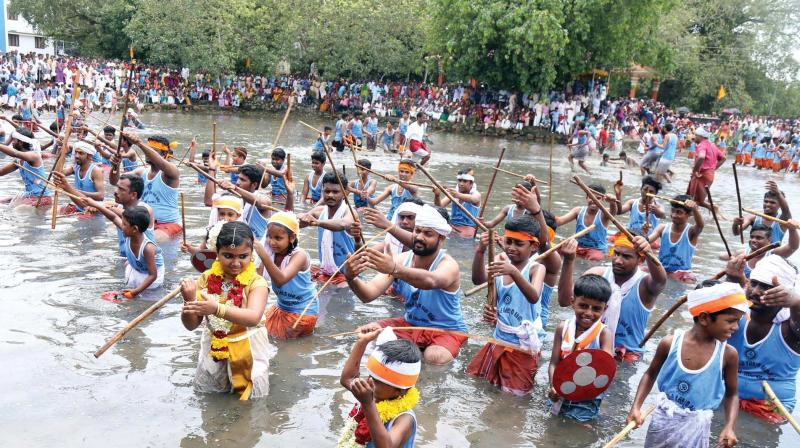
Ochira in Kollam has a temple with no idol and no walls, and every June its paddy fields become a battlefield. The story of Ochira Kali, the mock war that keeps an old rivalry alive with sticks, drums and mud.
Most temples in Kerala are built around a shrine. You take off your footwear, walk past a gate, and arrive at a small dark room where a deity is kept. Ochira works the other way round. The Ochira Parabrahma Temple, on the highway between Kollam and Alappuzha, has no idol and no sanctum. It has about 36 acres of open land, two banyan platforms, a few small shrines at the edges and a belief that the supreme consciousness cannot be fitted inside four walls.
The land itself is the temple. Pilgrims who come here in November for the twelve day Panthrandu Villakku stay in thatched huts on the open ground, and nobody asks who they are or what they own. Bulls wander through the compound. A local story explains why. A scholar was walking on a spiritual journey with his servant, and the servant kept asking what Parabrahma looks like. To end the questions, the scholar said it looked like a big bull. The servant meditated on that picture until the supreme being appeared to him in that form.
Then, on the first two days of the Malayalam month of Mithunam, the quiet land goes to war.
A battlefield with a rule book
The fighting takes place in the waterlogged paddy fields beside the temple, called padanilams. Men and boys from the surrounding villages, known as karas, line up in two groups. Outlook Traveller counts about 3,000 fighters from 52 localities. They wear old military style costumes and carry sticks or canes and shields, and they fight in a style based on Kalaripayattu.
It begins with a sign from the sky. The festival waits for a Brahminy kite, the bird said to carry Lord Krishna, to fly over the field. Once it appears, the leaders of the two sides run to the padanilam and announce that the battle will be fought the next day. On that day the fighters gather and show what they can do, to the beat of the chenda drums. One side advances while the other holds back, and then they swap. Water and mud are splashed across the field. Kerala Tourism describes the mood as playful yet intense, which is hard to argue with when thousands of men are knocking sticks together in the wet.
When the fighting ends, there is a feast. Gurus called asans receive awards from the temple, and the performers get prize money. Plenty of Kerala's rituals are performed for an audience, but here the crowd stands on the bank and watches a war game that the whole region takes part in.
Whose war is it?
The accounts do not agree on who the original enemies were. Kerala Tourism says the battle remembers the clash between Marthanda Varma of Travancore and the Raja of Kayamkulam, and also describes it as the Kayamkulam and Ambalapuzha kingdoms. Outlook Traveller names Kayamkulam and Venad and says the conflicts were fought about two centuries ago. The honest reading is that it remembers a period of fighting between neighbouring kingdoms on this stretch of the coast, and that the details have blurred while the ritual has stayed.
What is clear is why it survives. The fight is a ritual of the temple, so the whole region joins in. Old rivalries between villages are played out with sticks and mud and then closed with a meal.
Going to see it
The next Ochira Kali is expected on 16 and 17 June 2027, although festival dates in Kerala follow the Malayalam calendar and the temple confirms them closer to the time. Ochira is about 104 km from Thiruvananthapuram airport, and Kayamkulam Junction, around 7 km away, is the most convenient railway station. There are no direct buses from Kollam, so buses run to Karunagappally and you change there. It is monsoon season, so carry something waterproof for yourself and your camera, and expect to stand in the rain if you want a clear view of the field.
Sources: Kerala Tourism, Ochira Kali; Outlook Traveller, Ochira Kali
Have a travel story to share? Write for us